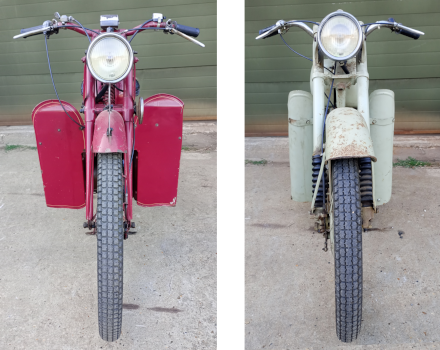

Late in 1948, Villiers announced to its motor cycle customers that it would be producing two new engines of 47mm bore × 57mm stroke for 99cc. A kick-started, two-speed, trigger-change, 1F motor for light motor cycles, and a single-speed 2F motor intended for pedal-start autocycles.
The pre-war Villiers Junior De Luxe engine was to be discontinued and, since the 2F engine mountings were completely different, manufacturers wishing to continue producing autocycles with the 2F engine would need to design new frames to take them.
Both new engine types became available in 1949, with some builders speedily getting their new 1F motor cycles and 2F autocycle models into production during the same year, while other makers holding stocks of JDL engines delayed getting their new autocycle models to market until the older engine types were cleared.
James was one of those manufacturers that got its new 1F Comet light motor cycle to market in 1949, but delayed its autocycle transition till the following year.
In 1949 the wartime James Military Lightweight (ML model) had reached the end of its post-war service, was demobilised, and was replaced by two new Comet light motor cycle models powered by the latest two-speed Villiers 1F engine. The new Comets used a similar style of James tubular girder forks in a new frame, with sturdy 21" wheels, and a new ‘teardrop’ fuel tank. There were two versions: the Standard Comet motor cycle with AC lighting, and the De Luxe Comet motor cycle with battery and rectified DC lighting set. Period James advertising literature claimed these bikes were ‘capable of a comfortable 40 miles per hour’.
The new 2F Superlux autocycle was listed for sale in 1950, and in February 1950 a further 99cc motor cycle model was seen in prototype form, being a two-speed 1F Comet fitted with ‘extensive weather protection’. This was comprised of enclosure panels that ran from leg shields at the front, back to the rear wheel spindle, and from footrest level up to the cylinder head. A windscreen was also fitted, and this model was tried by a staff member from The Motor Cycle on 23 February 1950.
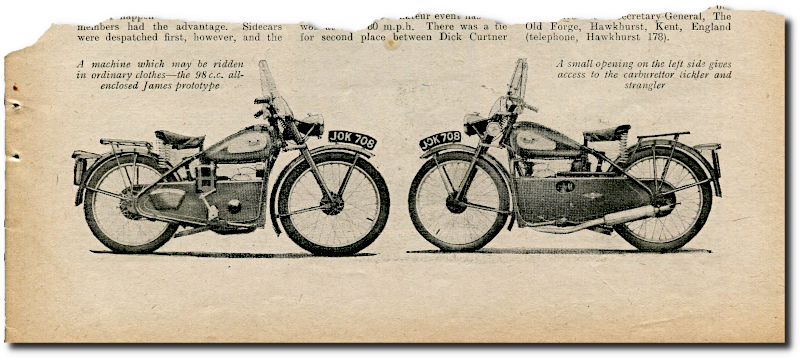
The prototype of the as yet unnamed Commodore.
The battery and the ‘kidney’ toolbox would not be carried through to the
production version.
On 16 November 1950, The Motor Cycle presented a ‘James Programme’ article on models for the forthcoming season. Comparative model prices at this time were:
99cc 2F Superlux autocycle £61–11s–11d,
99cc 1F Standard Comet motor cycle £63–10s–0d (with AC lighting) ,
99cc 1F De-Luxe Comet motor cycle £69–17s–0d (with battery and rectified DC lighting set),
99cc 1F Commodore motor cycle also £69–17s–0d (with AC lighting) & a given weight of 148lbs).
The Commodore joined the range for 1951 fitted with James’s own tubular girder forks and presented as having ‘a neat enclosure and built-in leg shields-cum-safety bars’. This new motor cycle otherwise continued with minor detail changes only, and remained the same into 1952.
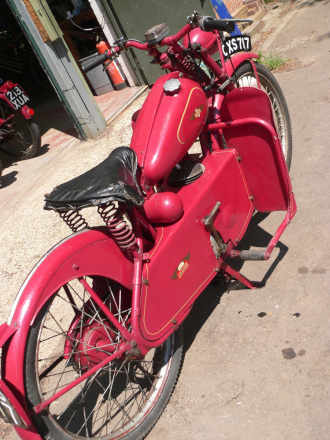
Our featured bike seemed to have lost its original registration somewhere along the way, and dated for re-registration as 1952, and since this is the only example we’ve ever seen, we’re keen to examine its details...
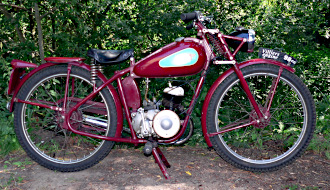
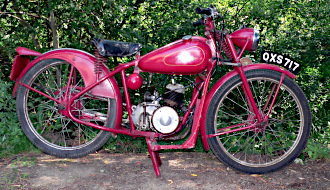
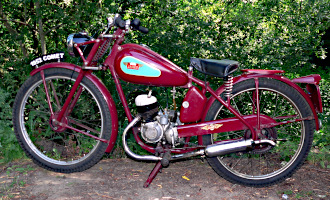
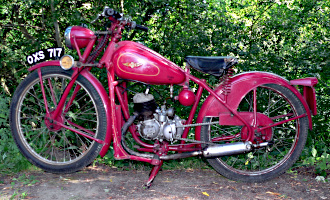
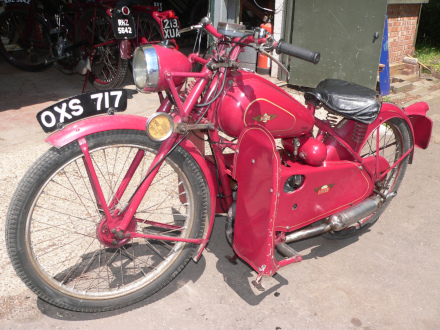
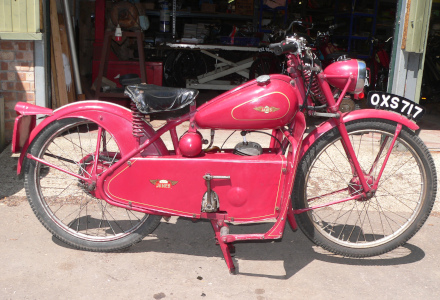
The Commodore is based upon the Standard Comet, though marketed on additional features presented as ‘weather protection’ contributing to added value. There’s a crash bar set mounted off the front frame down tube, looping down and back for fixing at the ends of the footrests, with leg shields fixed to the crash bars, additional valance panels on the sides of the rear mudguard, with the main obvious feature being the side panels. It’s not until you remove these side panels that you appreciate the pros and cons of the addition of these weather covers.
Comparing pictures of both sides of a 1F Comet and the Commodore with its panels removed, reveals the frames are indeed the same. The Commodore retains the original style round Comet toolbox, since the side panels would clash with the later long ‘kidney’ toolbox and, somewhat strangely, the Commodore chain guard is cut off shorter within the side panels! What this would seem to mean is that, as well as the lower run of the chain, the upper run of the chain is also going to be contributing to oil & grease thrown around the inside of the engine covers.
No matter, nice and easy-clean on the outside, but when you take the panels off, the splattered yuck is going to be waiting on the inside when you need to service something … you should always put a rag in the nice round toolbox!
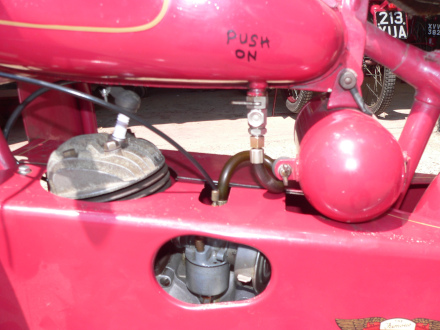
Since the cylinder head & spark plug protrude through the top of the panels (which makes sense), actual removal of the side panels is easy enough, and allows you to examine how the panels are formed. The panel construction is comprised of a single radius form at the top, with a hand-safe edge (without wire bead) formed around the main panel to stiffen it up. The top joint between the panels requires simultaneously locating five fingers to engage the swaged channel on the opposing panel, which can be somewhat difficult. It also needs the kick-start tied down or removed to be able to locate the lower right-hand panel for re-assembly.
Removal of the side panels is needed to service the Villiers Junior carburettor and to check oil levels, and you really wouldn’t want to be taking these panels off by the side of the road.
Time to drag out the scales to check the weights, back 5st 11lb, front 5st 4lb, so quite well balanced, and a total weight 11st 1lb (155lb with oil and fuel).
Time to ride, and the push on–push off–reserve fuel tap is readily accessible above the side panels and beneath the tank in the usual position, while access to the tickler/flood button and air filter strangler is through a port in the lefty-hand side panel. Following warnings that the motor can be temperamental, it fires up first kick, and settles down to a docile tickover by just occasionally fractionally tweaking the twist-grip, since there’s no throttle stop on a Junior carb.
The trigger change gear mechanisms are notoriously bad for crunchy selection and tendencies to disengage when you think you’ve located the gear, so we’re prepared for that. Gear location can be improved by taking your time through changes, but there’s no guarantee of success with this selector.
Maximum speed in first gear is given as 30mph, but pushing up to that level of revs in low gear would be pointless and unnecessary since the torque is quite capable of pulling satisfactorily by engaging second around 15–20 mph. Our highest reading on the handlebar mounted Sat-Tracker clocked 36mph on the flat, though the speed was still slowly building up when we started running out of straight and had to shut down, so the presumption was that it would be capable of more.
The low saddle height gives a comfortable riding position, and we’re surprised that there was no perceptible resonation from the additional panels, so it’s just like riding a 1F Comet.
The leg shields however are large and flat, presenting the frontal profile of a barn door, and a big fat zero in the way of stylish aerodynamics.
Having a left foot-operated rod brake is always going to be helpful for your stopping power, even with 70+ year old tech, though the front lever handlebar brake also functioned effectively. With the trigger change on the handlebar, your right foot has nothing to do while waiting for Villiers to develop its 6F engine somewhere in the distant future.
It appears that the Commodore shared frame numbers with the Comet 1F, so with no means of differentiating the models, and no surviving factory records, there seems no way to confirm how many Commodores were made.
The 1F Commodore was re-designated as the J4 model for the 1953 season, and now priced at £83–1s–1d.
As the 1F Comet engine switched to the new Villiers 4F engine in October 1953, so also did the J4 (Commodore), and its designation was changed to J3 to identify this change. It would seem this coding might have been allocated earlier in anticipation of the forthcoming Villiers engine upgrade, however the Commodore seemed to have been a particularly poor seller, and it maybe that few (if any) J3s were actually built with 4F engines at this late stage in the last quarter of the year.
In June 1953 a telescopic fork conversion became available for all 99cc models, which would become standard fitment for the Comet in 1954, while the Commodore was just de-listed, so it seems further unlikely that any Commodore J4, or J3 versions were ever produced from the factory with telescopic fork sets installed.
Right from the start, James’s marketing touted the side panels as the key feature of the Commodore weather protection scheme, but this seems absurd since the panels are only enclosing the engine, which doesn’t need any weather protection, and the engine shields offer no protection whatsoever for the rider!
The full width leg shields mounted on the crash bars presented a stout frontal profile, and offered some degree of adverse weather protection for the rider, as did addition of side valances to the rear mudguard to reduce side spray—but these are basic components, which could simply be fitted as accessories to a Comet.
It seemed that there was fairly limited customer interest in the Commodore model, which was only listed for three years.
Moving on a couple of years finds a shrinking number of manufacturers presenting new 99cc motor cycles at the November 1956 Earls Court motor cycle show, with the latest 6F, two-speed foot-change motor that had been announced by Villiers earlier in the year.
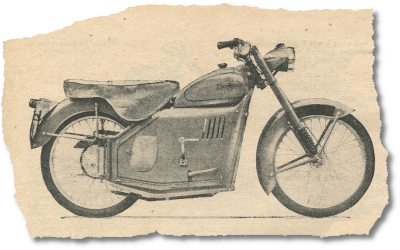
Pre-production Excelsior Consort
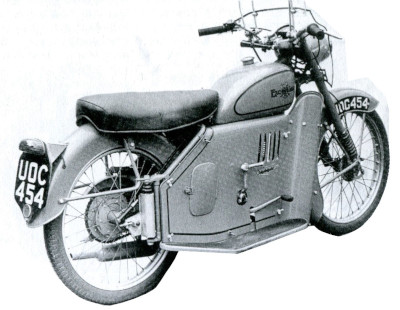
Production Excelsior Consort
Excelsior had managed to jump ahead of the game by introducing F4 and F4S Consorts fitted with 6F engines during 1956; these were joined by a third version on Excelsior’s Stand 42 at Earls Court, where it presented its new SB1 Skutabyk (Excelsior never could spell properly) for the coming 1957 season.
The run up to the 1956 Earls Court Show was a time when increasing numbers of imported mopeds were reaching the UK market, and demand for autocycles had crashed, so the 1957 season was the point that Excelsior had decided to withdraw its two outdated S1 & G2 Autobyks following a ten-year run. Since Excelsior never produced or factored any mopeds, only 99cc two-speed motor cycle models now remained within its smallest capacity. The Skutabyk was based on the F4S Consort plunger sprung frame, though having telescopic forks in place of the Consort’s tubular girder forks. The 2.50×19 wheels were covered by deep-sided mudguards, and the frame was equipped with engine panels, leg shields, a dual seat, and extended footboards instead of rear footrests—so the Skutabyk seemed like a return to the earlier ‘weather protection’ theme!
Excelsior didn’t seem to have learned much from the James Commodore’s failure of five years earlier, and seemingly thought it could do better with the same concept of weather protection.
Less idea … more, Oh dear!
Skutabyk seemed to revisit the concept, with maybe the ugliest great side panels, leg shields and hideous footboard assemblies topped with rubber mats, ever fitted to a light motor cycle. Presumably there were some folks who thought this was stylish in its day, since some sales were already being completed and bikes delivered before the end of November 1956!
Excelsior seems to have published early adverts with pictures of prototype models, which can be identified with ‘padded ears’ as extensions under the front of the seat and were described as ‘pillion knee-grips’, and also illustrated a small diameter black exhaust tailpipe emerging from underneath the right-hand foot boards. Neither of these features seems to have appeared on actual production models, with the dual-seat having a conventional flat base, and a standard Consort exhaust system mounted on the left-hand side with a chrome silencer emerging from underneath the left-hand footboards.
Listed optional extras were a speedometer set for £4, and a windscreen for £3–5s–6d, but neither of these features were likely to make the bike any more visually desirable. The sales price for a 1957 Skutabyk was posted at £94–17s–3d, and its weight given as 160lbs (11½ stone).
Press reviews reported ‘combines the modern trend of enclosure with the best features of scooter design’, and further described as having ‘all-weather character’. We think they were being generous, but to be fair, Excelsior didn’t seem to be presenting the Skutabyk on weather protection, their chosen advertising theme was ‘appearance’ and ‘clean lines’.
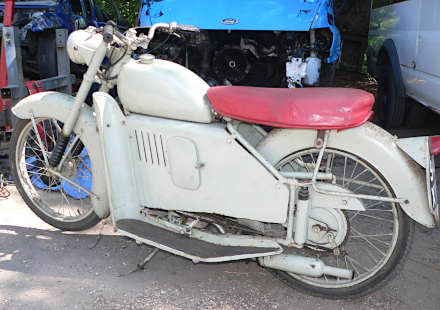
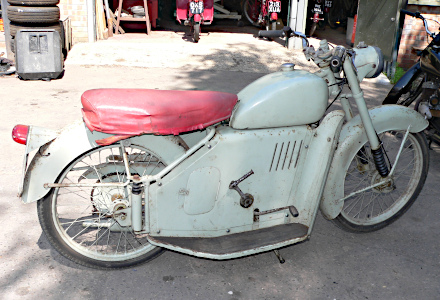
This is a rare opportunity to check around features of the bike since this is also the first time we’ve ever seen a Skutabyk. The headlamp looks to be a VEC with a Lucas switch, while welded lever brackets on the handlebars greatly help to tidy up the handlebars with only the beam–dip–horn switch mounted on them. The telescopic front forks look particularly stout for a small capacity machine, and feature sturdy cast steel yokes for a very industrial appearance with little concern for style.
The fuel tank looks like conventional Consort, below which are the mighty side panels that extend from below the front of the tank to just in front of the rear plunger units, and down to the bottom of the frame tubes. The leg shields are bolted to the front of the side panels, and the footboards are bolted to the bottom of the side panels; all of which are firmly bolted to both sides of the frame.
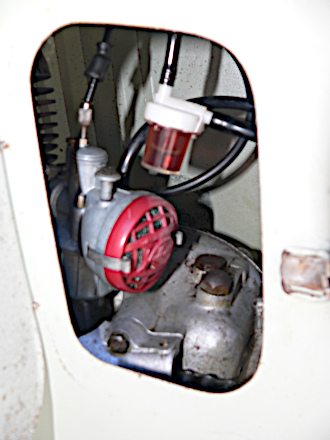
The only access to the engine is either from the front between the leg shields (very difficult), or by opening the left-hand latched cover door to operate the flood button and choke on the Villiers S12 carburettor. It’s unclear how you achieve practical access to the spark plug, or the petrol tap, which is still underneath the back of the fuel tank and within the depths of the side panels.
The only way is to reach inside the access port and grope around to figure out what type of tap it is … feels like a Ewarts tap, but you also need to feel which way round the plunger is … it’s facing back to us, so we have to push the plunger away to open the tap. We wonder who thought this was a good idea?
The footbrake lever sits outside the left-hand panel, with the rod to the rear hub operating though the inside of the panel.
The latched cover door in the right-hand panel gives access to a shallow toolbox that is built into the back of the panel, so no way inside by this route. A kickstart and gear lever poke out through the right-hand panel from the engine inside.
There are five vertical louvres pressed into the upper fronts of both panel sides, though these look more ornamental than providing essential ventilation to the engine.
So what might be involved when you need to take off the side panels? Apparently ‘the engine panels, fixed in position by wing-nuts, are readily removable’, but 70 years later these are long gone, and it only has bolts now, so you might need to carry a suitable spanner in the toolbox.
The dual saddle on our bike has the flat base, where just a few years earlier the ‘side ears’ were a brief Excelsior feature on several of their models in the early 1950s, but the style now seemed to be past its moment as these ‘padded kneegrips’ were deleted from the Skutabyk before it even reached production.
The number plate & rear lamp bracket is heavily ‘faired’ with triangular braces spot-welded into place to make it particularly structural, in comparison to typical mounts.
Skutabyk is solidly built like a tank, though it looks a bit like a tank too.
The rear lamp lens doesn’t seem like anything that we’ve seen before, and the lens moulding is marked ‘A Walker Product’ … interesting, we wonder what that is?
A Walker Product
The rear light was Excelsior's own product.
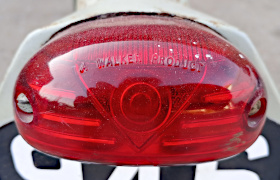
Photo: D Watson
It was R Walker & Son that took over Bayliss, Thomas & Co in 1917 and renamed it to Excelsior Motor Co. Reginald Walker was Chairman of Excelsior until 1946 when his son, R Eric Walker, took over. The firm of R Walker & Son seems to have morphed into R E Walker & Son (presumably with Eric at the helm while his dad ran Excelsior) and kept going as part of 'The Excelsior Organisation' as a manufacturer of accessories. When the Skutabike was first shown at Earls Court in 1956 on Stand 42, R E Walker & Son were exhibiting upstairs on stand 94.
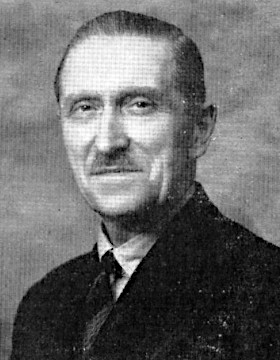
R Eric Walker MBE
Going from previous experiences with Excelsior centre stands, we’ve come prepared with a tape to check how horrible it is to handle. With the rear wheel already measuring 1" clear of the ground, we have to lift the bike up a further 4", and travel forward 16" just to get the bike off the stand. This takes a lot of physical effort lifting an 11½-stone bike, and requires the same effort every time you want to put it on and off the stand. It’s very secure when the bike is on the stand, but requires way too much physical effort. You can really get to hate this stand, so much so that leaning it against fences and walls becomes so much easier!
It’s probably getting towards the time to see if it rides as well (or badly) as it looks, and just a couple of jabs on the kickstart gets the engine started, and it seems to run OK! We run the motor to warm for a few minutes, then clutch in and foot-change up for first, which shifts lightly and engages easily. A little throttle, feed in the clutch, and the engine pulls eagerly and strongly. Leaving the industrial site and turning into the road, clutch in and click through neutral and down into second. Again the foot-change is light and locates the gear right away.
The selector on the 6F engine doesn’t return the gear lever to the centre position, so it stays in the up position where you left it when you engaged first. That’s how it works, it’s meant to do that, and the gear lever also stays down when you switch into second. The gear lever only stays in middle position when neutral is selected.
Once in second, the motor torque seems enough to lumber the bike up to speed once it’s rolling, so through a slow bendy section there’s no need to change back down. Opening the throttle as we emerge onto the straight, tuck down to help the speed build up quicker, and again we manage to clock 36mph on the handlebar mounted Sat-Tracker with the speed still slowly building up before we start running out of road and have to shut down.
The footplates allow you to settle your foot position more easily to locate the gear lever & brake pedal than on the 6F Consort, which usually requires your foot raising off the rest to find the lever, as it’s generally out of reach from the foot peg.
There was some small vibration from the leg shields, but way less than expected considering all the panels.
The Skutabyk is built with all the elegance of a pre-dreadnought battleship, but you don’t notice this when you’re riding the bike. It goes fine, handles and stops quite capably, though we couldn’t comment on the lights since none of the electrics seemed to work.
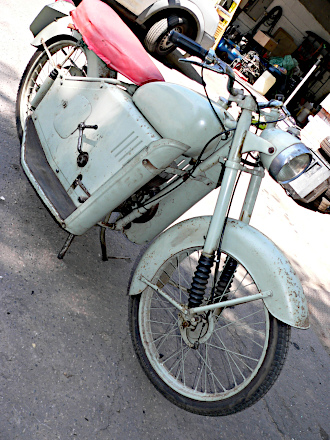
Looking over our Skutabyk has been like reading a review of a 1950s’ ‘B’-horror movie, which has generally not been good, but it’s not all bad, and the bike certainly has a unique character.
It’s easy to see where the worst weaknesses are in the machine, and they’re mostly related to the side panels. The footplates with the rubber mats are a sure trap for water and corrosion and, if the bike goes over, then these sheet metal fabrications appear vulnerable to getting bent up, which looks suspiciously how the left-hand footplate of our bike may have suffered.
Access to the petrol tap is a right pain, and it looks like a major job to access the engine, which seems way more difficult than scooters, where the side panels are usually more easily removed by a simple latch lever.
So why did Excelsior fit the Skutabyk with seemingly pointless side panels?
They didn’t seem to claim they were part of any weather protection scheme, so maybe the conclusion could be that they wanted to pretend that their motor cycle was a scooter? Scooters had already established an important market share to the cost of light motor cycle sales, so maybe the misspelt Skutabyk name was a clue?
By May 1959 Excelsior had announced two actual new Monarch scooter models of their own, as the KS and EL. These were based on the bodyshell of the DKR scooter fitted with Excelsior’s own 150cc engine that was fitted into its Courier motor cycle models from 1953.
In 1958 the Skutabyk had been listed for £106–13s–8d, though with zero national inflation in 1959, was reduced to £103–10s–11d, presumably to encourage the clearance of stock, since the model was de-listed for 1960. The Skutabyk seemed to employ its own SK-prefixed frame numbers, with serialisation records suggesting some 1,900 bikes may have been built over the three-year period it was sold.