Born in 1908, Aldo Guazzoni went to work as a mechanic for a Milanese motor cycle dealer, before developing his own motor cycle using a 500cc Calthorpe single-cylinder four-stroke engine from England, and establishing his own Moto Guazzoni company in 1935. The motor cycle, however, found little interest in the Italian market, so Aldo switched to building more popular three-wheeler transport machines instead.
Following World War II, Guazzoni established a Milanese dealership for the Moto Morini company, and returned to motor cycle building activities in 1950 using an FBM 250cc two-stroke single from the newly formed Fabbrica Bolognese Motori company in Bologna. This enabled Guazzoni to establish its motor cycle assembly lines during 1951, to bring a 150cc FBM two-stroke single ‘Grifo’ lightweight to market in 1952 as Tourer, Sport, and Premium Sport models; this achieved immediate sales success, and won its class in the 24-hour Belgian Enduro of Warsage. Following this victory as fastest bike of its category, with 10.5HP and 125–130km/h, a new Guazzoni Bol d’Or 175cc model was introduced.
For 1953 the company presented another new 150cc two-stroke model called the ‘Snout’; its name was a reference to the engine, which had a horizontal cylinder.
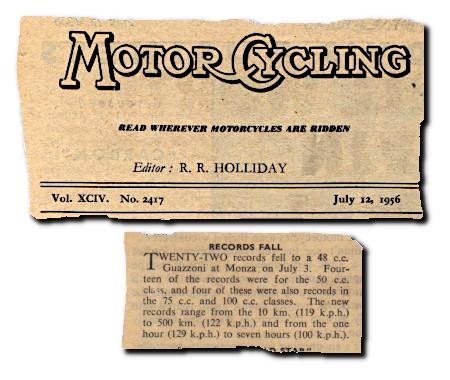
In 1955 Guazzoni created a 200cc single-cylinder SOHC four-stroke motor cycle as a change from its usual two-strokes while, over the two-year period 1955–56, a Guazzoni ‘Torpedo’ 50cc two-stroke took 30 world records at the Monza race circuit. Although it was just a 50, it also took records in the 75 and 100 classes.
In the later 1950s, many Italian motor cycle manufacturers were entering a financial depression through falling sales, which was made worse for Guazzoni because of its involvement in the Argentine market. Following the revolutionary fall of the Juan Domingo Perón administration in 1957, restoration of the 1853 Constitution, and addition of the protectionist article 14 bis, which froze foreign businesses out from being paid for delivered goods, and further prevented them from recovering their assets. Guazzoni consequently lost some 1,000 motor cycles that had already been delivered to dealers. This was a serious economic blow for the small Milan factory, and left Aldo in such a serious financial position that he was forced to restructure the company.
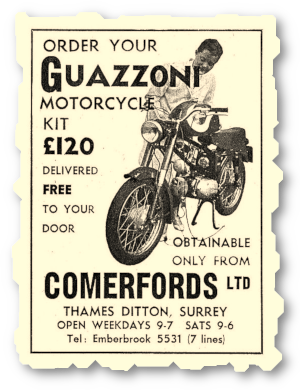
The Dot company of Manchester began factoring Guazzoni 98cc and 175cc ‘Sport’ two-stroke singles with horizontal cylinders priced at £169-18s-0d in 1960, but by 1962 Dot had already de-listed the machines as Comerfords Ltd of Thames Ditton had seemingly ‘pinched’ the business and were advertising apparently the same Guazzoni 175 model ‘delivered to your door’ in kit form for £120.
In 1961 Aldo relocated his company to an old mill in Via Altaguardia, where he continued production of an early model Guazzoni Sport 50cc using the FBM engine, and other moped models, but also diversified into machine tools and disc-valve induction engines for other applications such as outboard motors and go-karts.
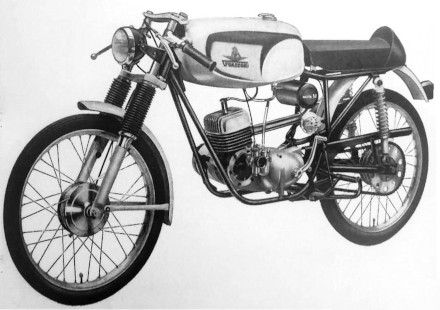
In 1965 Guazzoni introduced a new Sports 50cc called Matta, which became the very first Italian motor cycle with disc-valve induction, and offering more performance due to the improved intake porting control that the system offers over the limitations of conventional piston ported designs. The initial ‘Export’ version was rated 6bhp for 100km/h.
The Matta name was chosen to advertise the performance and versatility of the motor, and became readily adopted by younger riders because of its engine power and flexibility—Matta translates into English as ‘Crazy’.
The two-stroke rotary disc-valve originated from a German DKW RadMeister engine design, which first found its way into the Cyclemaster and Berini M13 cyclemotors of the 1950s, during which time MZ in East Germany was further developing the principle for racing engines—and was achieving results! However, Ernst Degner’s 1961 defection and escape to Suzuki meant the MZ two-stroke design secrets slipped away to Japan along with him and his family.
It wasn’t long before Suzuki was joined by Bridgestone, Yamaha, and Kawasaki in producing road going disc-valve motor cycles. The MZ-RE50 disc-valve racer, 1962 Suzuki RM62 disc-valve racer, and subsequent RM63 and RM64 racers are probably what inspired the Guazzoni Matta because you can certainly see a number of shared aspects in the designs.
The Guazzoni Matta was a new generation of Sports 50 with models for on-road, off-road, and on the racetrack in the form of a production racer delivered to the public in 1965. Though never produced as a series or long run model, its slender and sleek appearance led some comparison to anorexia gone mad!
The production racer, fitted with its 17mm carburettor and engine of 41mm bore × 37.5mm stroke for 49.5cc, developing 13bhp at 13,500rpm, for a top speed in the region of 180km/h—err, that’s 112mph!
Suspension at both ends was Ceriani, with either 28mm or 30mm fork stanchions, and later racers developed with a six-speed gearbox and could reportedly pull up to 15,000 revs!
There was also a Cadetti model with 45mm bore and the same 37.5mm stroke for a 60cc engine size.
Earlier Matta racer models could be fitted with an Italfreno front hub, while later versions might be equipped with a magnesium 180mm Fontana hub and the Matta ‘Racer’ could cost twice the price of a ‘Sport’ model, though carrying the same fuel tank and seat with a very similar frame.
It all sounds quite confusing, and to identify the respective models probably requires a knowledgeable specialist, and we’re not that, so how might we be able to figure out quite what specification our feature bike is?
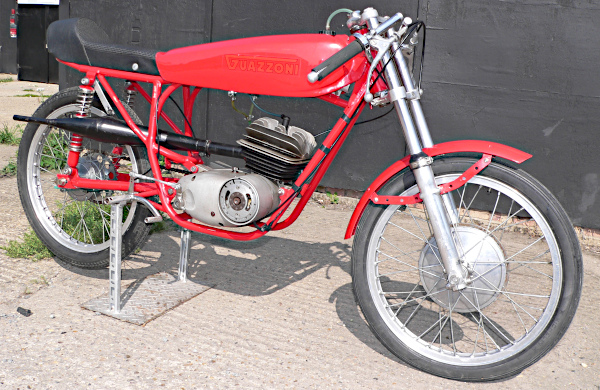
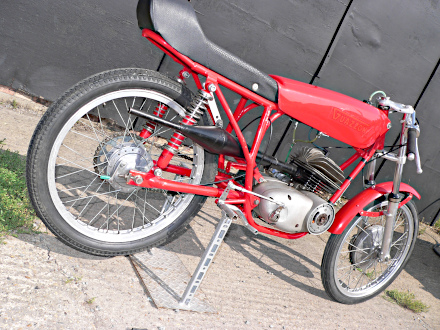
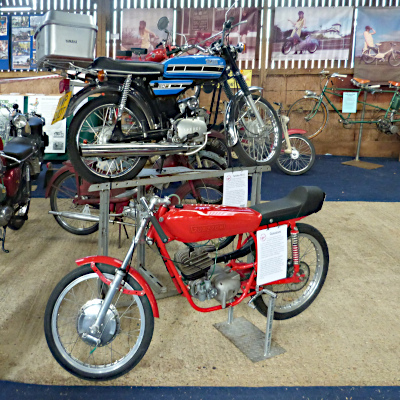
Here it is, beautiful, spectacular, and maybe a little menacing—because if it is the whole ticket, would you be ready to try doing over 110mph on a miniature 50cc racer? We don’t really know which Guazzoni version we have at this point, it looks like a racer, but might just be a ‘stylised’ lower powered Matta road version.
Just for reference, we put the bike on the scales, 4st 9lb front & 4st 12lb rear = total 9st 7lb (133lb
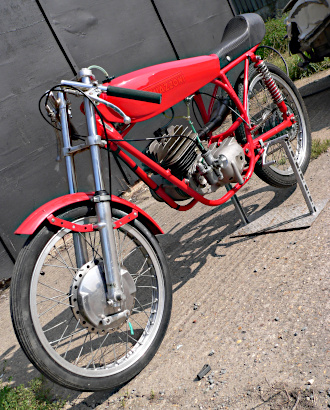
The twin down-tube cradle frame is installed with very nice Ceriani forks with alloy yokes and alloy bottom legs on 30mm stanchions, and a rear swing-arm with Ceriani rear shock units.
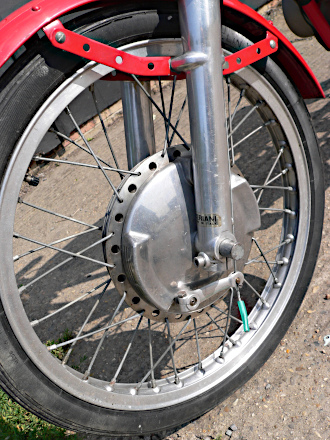
There’s a Grimeca alloy rear hub with a 90mm brake and fitted with what looks like a new alloy rear sprocket. We don’t know the make, but the very impressive half-width alloy front hub sports a radially finned brake ring, with 160mm cast alloy single-leading brake-plate with air-scoop. The hubs are laced into deep-gulley alloy rims, and though we couldn’t find any indication of the make, they’re very nice rims. The front wheel is fitted with a Michelin 2.00 – 18 radial rib tyre, with a Michelin Rapido 2¼ – 18 moped tyre on the rear, which would be a bit of a worry if this is a full race spec Matta, because we absolutely wouldn’t want to be doing 100mph+ on this tyre!
The tank is a particularly elegant fibreglass moulding, though it probably has a small capacity as, when we lift the cap to refuel, it seems as if the bottom of the tank is right beneath the filler! An external HT coil is located under the fuel tank and powered from a mag-set of unknown make, which obviously has a low-tension output coil, but also seems to have a second (presumably lighting generator) coil—though there’s no electrical set, which could suggest that this is may not be a race spec motor.
The ‘fastback’ saddle is another stylish match to blend with the tank, but again we can’t identify whether it’s a recovered original.
There are no pillion footrests on this Guazzoni, and though it might look as if it this could be a dual-seat, it’s really just a single saddle. The footrests are a rear-set linkage, with a cable-operated footbrake on the left, and a four-speed change on the right: 1-up, 3-down. The saddle height of 26", but just 16" height from the rear-set footrests to the top of the saddle, means your legs are folded in the riding position, and you’re stretched out across the tank to reach the clip-on bars on the fork stanchions.
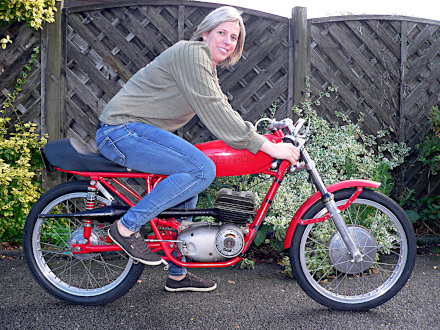
Rachel demonstrates a stationary ‘head-up’ riding position with one foot still down, so the scale and normal riding position might be easier to appreciate—there really is no space for a passenger.
We are probably twice the weight of Rachel and the minute contortionists that used to ride these 50cc racers, so at best we’re probably going to find it ‘uncomfortable’ to even sit in the riding position, and it’s likely going to be even more difficult to operate the foot controls…
The Guazzoni motor looks like a very serious piece of equipment, with a most substantially built crankcase. For a 50cc engine, it has imposing fin arrangements on the iron cylinder and radial-fin alloy head, and though we don’t know the actual compression ratio on our bike, we’ve seen figures up to 17:1 quoted for the race engines! The motor really needs these big fins to disperse the generated heat, particularly as the Matta is built with a rear facing port with the exhaust pipe exiting straight out the back of the cylinder through a race expansion system. This layout is notorious for heat dispersal issues, which is why it’s rarely seen, but temptingly promises more efficient exhaust gas scavenging … and it looks spectacular.
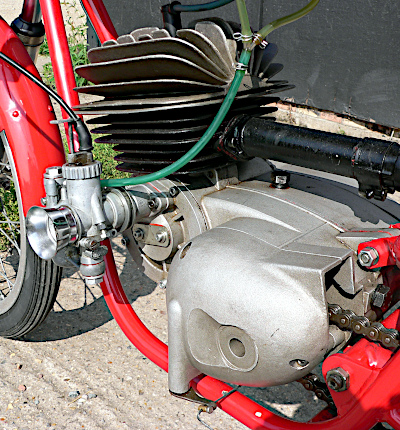
The other exceptional engine feature as a result of the disc-valve, is the carburettor mounted out the left side of the motor at 90º with a direct open intake! The Guazzoni really looks amazing.
While the engines were known to be originally fitted with 17mm, or later MA18B carburettors, this motor is fitted with a Dell’orto 20mm UB20S, which is likely not original, and is a pretty big carb for any 50!
Our bike might be a racer-styled standard spec Matta, but there’s also some prospect that it still may also be a race version, we still don’t know, and we’re somewhat apprehensive about trying to ride a 50 maybe capable of 110+mph on moped tyres!
Our Guazzoni is road registered and street legal, but has no means of standing up on its own, and generally resides on a paddock stand, so has to be lifted off when you want to use it. This is a bit inconvenient since you can’t carry the paddock stand with you, so would have to lean the bike against walls if you stop anywhere—though not such an issue on a racetrack.
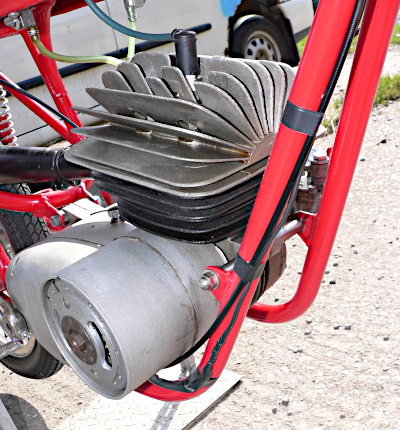
There are fuel taps off–on–res under both sides of the tank, so take your pick.
The Dell’orto has a choke and flood button, and during our initial debugging of the bike, both methods seemed equally effective for starting the motor. First efforts found the gear selection was stiff, which was resolved by topping up the low transmission oil level and lubricating the rear-set linkage.
The second trial run found the un-silenced expansion box wasn’t overly loud, but a slipping clutch limited capability to 30mph. Adjustments resolved the problem, so our third attempt became the official paced run.
Like any proper race bike, our Guazzoni has no kick-start, so just like a racer we have to do a push-start. Having done a couple of these already, we find selecting second works best, pull in the clutch, sit on the saddle, scoot the bike down the drive, drop the clutch and keep scooting. The motor readily and easily starts. Only low throttle is required, so just pull in the clutch and shift back to neutral to warm the motor.
The surprisingly light action clutch lever only starts to bite toward the end of its release, while first gear feels to be quite high when pulling off, making us wonder if it might be a close ratio RRT box, still the motor readily pulls though, and shift down into second. The motor presses up to speed in the urban limit, though fourth at 30 feels too high so we drop back to third and carry on cruising to out of town. Entering the open limits, we stay in third for the uphill section and open the throttle to accelerate up the shallow gradient, then switch up into fourth along the flat to work heat into the motor for the return run.
Accelerating into the first short downhill section and switching into top doesn’t result in the speed accumulation we expected, so dropping back to third we open full throttle along the following flat (paced at 37mph), then switch into top and open up full again on the longer downhill section—but there’s still not enough gravity to increase the speed beyond 38mph!
We’re now convinced that this bike is over-geared for the power output of the motor. It completely fails to pull top gear, which is just one step beyond the capabilities of this engine. Fourth is an overdrive. Either the gearing wants reducing by a larger rear sprocket or smaller front sprocket, or the engine power needs to be increased.
Considering the low clip-on riding posture and tortuous seating position, the general handling, suspension and brakes were really good—and it still looks fantastic!
Guazzoni continued building classy lightweight on-road and off-road sports bikes and production racers throughout the 1960s and 1970s, mostly with 50, 98, 125 and 150cc engines. A 250cc Gran Turismo was advertised but may not have seen production.
In English language, crazy is just crazy … but in Italian, Matto = Crazy in the male tense, while Matta = Crazy in the female tense. Both versions translate as Crazy, but in the female tense, then technically, maybe Matta reads as ‘Crazy Woman’ … ?