
Leopoldo Rinaldi
Occasionally a really obscure machine turns up, but that invariably means there’s little information to be found about the maker. In this case there is practically nothing to find.
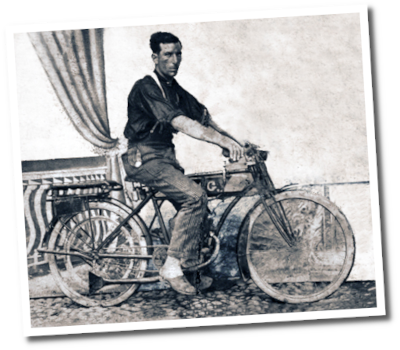
In 1898 Giovanni Rinaldi founded a bicycle factory in Bagnolo, near Nogarole Rocca, Veneto.
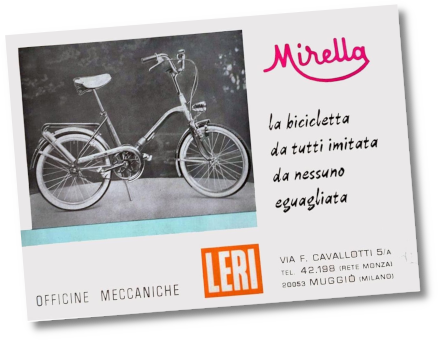
In 1923 his son Leopoldo moved the bicycle production to Cinisello Balsamo, in northern Milan, where he also began building motor cycles under the branding of Le.Ri (Leopoldo Rinaldi), and further introduced Mirella branded cycles (meaning ‘wonderful’, or ‘worthy of admiration’). Le.Ri produced mopeds in the 1950s and possibly into the 1960s.
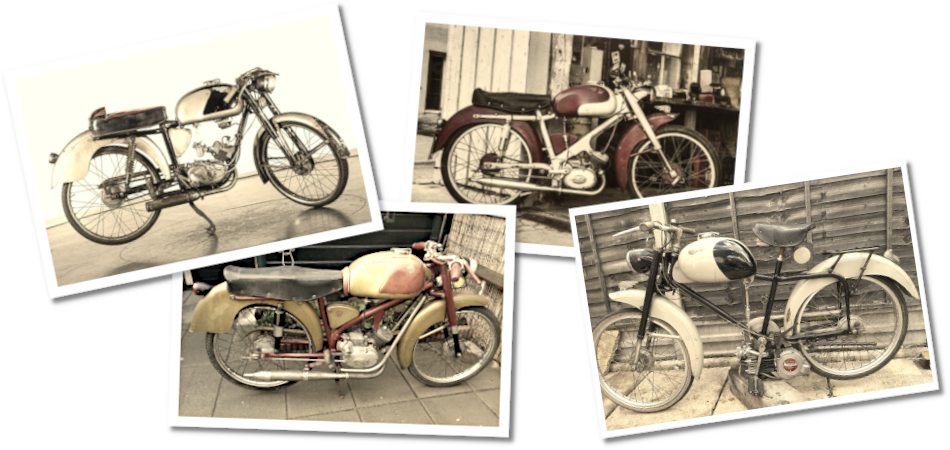
With very little to find in terms of general research into Le.Ri, analysis of our 1957 sports moped becomes particularly important.
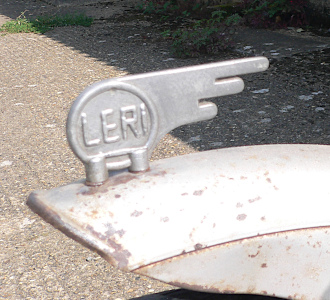
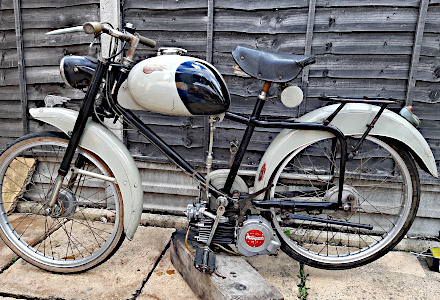
Your eye is immediately drawn to the unusual and eye-catching ‘LERI’ cast aluminium winged badge bolted the front mudguard, which is a feature that a number of period makes employed (NSU on its Quickly, etc).
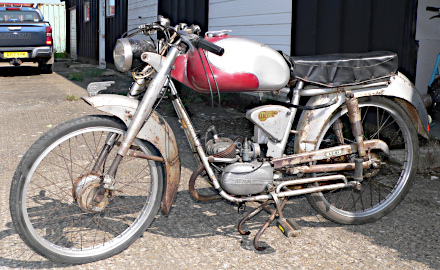
We start by measuring the length as 72" tip to tail, with a 47" wheelbase, and a 30" saddle height. Front weight is 3st 9lb and rear weight 4st 9lb, so total weight 8st 4lb (53kg, 116lb: the same as a Norman Super Lido), so seemingly there was little economy of materials in its construction.
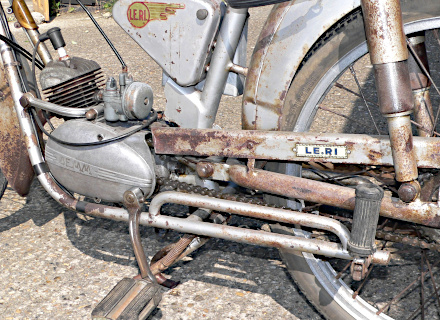
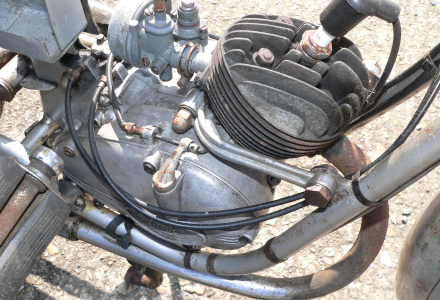
This sports moped frame is quite unique; we’ve never seen anything like it. It has a single spine frame, but with twin front down-tubes from the headstock, which continue on straight beneath the engine, to end at the rear footrests just a couple of inches ahead of the rear suspension bottom mounts! The footrest extensions are firmly braced by a formed tube welded above the primary tube on each side, which is why you see the doubled-up tubes to the rear footrests. Extraordinary!
Though the bike has a dual seat, we suspect that the rear footrests are not wholly intended for a pillion passenger—we think they’re also intended for the rider to sit back in a low profile crouch.
In front of the saddle, there’s a clip-on upholstered pad to act as a cushion against the back of the fuel tank, and a strap clipped onto brackets under the middle of the saddle frame. This strap obviously doubles-up for passenger use when clipped over the saddle, but also clips beneath the seat to be out of the way for the rider to readily slide back into a solo sports stance when required.
The frame has twin-shock swing-arm rear suspension with telescopic forks, and ‘Ace’ pattern handlebars mounted in elegantly styled brackets to lift the bars 2½" above the top yoke, and maximise a sporting though comfortable riding position.
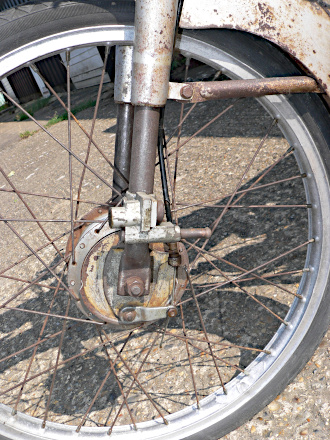
While studying the extraordinary engineering of the slim and elegant cast-steel front (right-hand) brake lever, we are further amazed that there are three cables connected to the lever! Having never before seen a triple-linked brake arrangement, we track the middle cable to the rear brake, and both side cables to the two double-sided, single-leading front brakes, and all three brake hubs look to be 100mm diameter, all operated at the same time by just the one hand lever! That single lever is likely to feel very heavy to operate with just one hand having to pull on three brakes, and you’re absolutely going to need a grip like a gorilla to expect much useful braking effect.
The full-width hubs are laced into old style gully pattern alloy rims, which look very aged and original … and you’d think were 19", but those tyres seem skinny and odd? Looking closer at the Pirelli tyres, they’re marked 2 × 20! Yes, that’s 20" rims, and you can bet that Pirelli doesn’t mould that size today … does anybody?
Both mudguards, however, are not made in the expected minimalist sports style, they’re heavily built steel guards with effective weatherproof side valances! So Le.Ri is not a stripped-to-the-bone lightweight racetrack machine, and maybe appears more as a road-going 50cc sports endurance machine for all-weather use.
The fuel tank appears to be the same as was fitted to the Victoria Avanti, and is even finished in the same paint scheme, but branded with obviously original old Le.Ri decals.
There’s a Veigel (German) 100km speedometer in the Aprilia headlamp shell, which is fitted with a larger Bosch BA20 bulb for a better light, but because of the double-sided front brake-plates preventing a speedo drive being fitted, the speedo drive is unusually relocated onto the drive side of the rear wheel! Unfortunately there is no speedo cable fitted, though it’d probably be difficult to find a suitable cable of the required length.
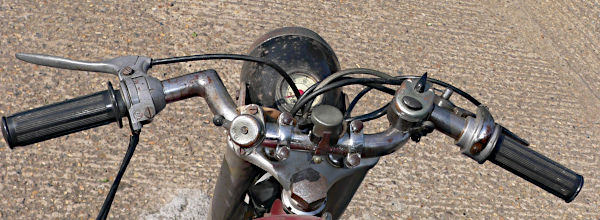
This isn’t a standard machine either, because there are several historical ‘tailored’ adaptations to our bike, as there are three switch sets on the handlebars, and all apparently wired! We don’t at this stage know what (if anything) the circuits may operate, but beyond the magdyno generator is an (empty) improvised battery carrier on the right-hand side of the bike. This is screwed to the back of the toolbox mounted on the right-hand side, though apparently no longer wired, but suggests it was previously used with a battery supported lighting system. Intriguing!
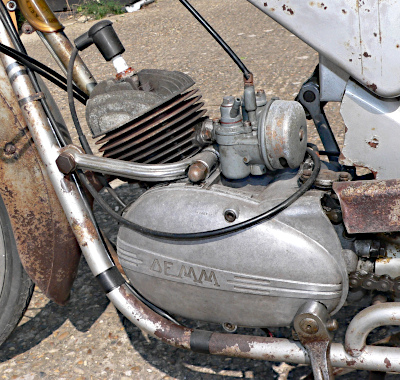
Le.Ri is fitted with a three-speed Demm hand-changed two-stroke 3M engine dated on the engine plate as 1957, with spec given as 40mm bore × 39mm stroke for 49cc with a low compression ratio of 6:1 producing 1.5bhp @ 5,200rpm. The three-speed hand-changer with twin control cables is marked with a Demm logo, so obviously made and sold as part of the engine kit.
While examining the engine we notice an odd knob on top of the gearbox, and after a bit of investigation and twiddling we find that switching it through 180º seems to change over the transmission from engine to pedal. The carburettor is a 14/12 Dellorto, so has a 12mm venturi, and looks similar to the carb fitted on the period Minarelli motor. The mag-set is an Autorotor, and no, we’ve never encountered one of these before.
So what’s the story on Demm?
In 1919 Giacomo Daldi and Luigi Matteucci started their first engineering workshop, which was formally registered in Milan in 1920 as Società Anonima F.lli Daldi and Matteucci.
On 15 April 1928, the business name was simplified to DEMM, as a simpler acronym for Daldi E Matteucci Milan, manufacturer of gears, machine tools, and measuring instruments.
Construction on the new Demm Porretta Terme plant started in 1938, and the 12,000m² facility was opened in 1939 with around 1,000 employees. During wartime, facilities were temporarily moved to Intra (Verbania) on Lake Maggiore in 1942, and production of precision measuring instruments began.
In producing components and gears for aeronautics during World War II, Demm became included on the Allied list as a ‘supplier of war materials’, following which, on 6 July 1944, the Porretta Terme plant was bombed and almost completely destroyed.
At the end of World War II the reconstruction of the Porretta Terme plant began, and was completed in 1947, when Demm’s production of measurement instruments and machine tools was resumed.
Demm built its first Diesel engine for tractors in 1952, and began production of own-branded motor cycles in 1953, from which the company became involved in competition events, setting 24 world speed records in the 50cc class in 1956. The company also progressed to building a proprietary 125cc two-stroke engine for selling to other motor cycle manufacturers, before launching its first complete Demm Dick-Dick moped in 1956, and further selling the two-speed & three-speed versions of the moped engines to Legnano and Testi during the late 1950s. A four-stroke 50cc engine model was also produced.
Test for a spark—yes, that looks fine. After flushing out the fuel tank and welding up a tiny pinhole, clear the completely blocked fuel tap, then clean out the carb. Fit a new fuel pipe (because it didn’t even have one), and we must conclude that this bike hasn’t been meaningfully run for quite some time. Now we finally have a reliable fuel supply, we top up the engine oil, pump up the tyres, and we’re ready to give it a try.
The Dell’orto 14/12 carb has no choke or strangler but relies on a sprung plunger on the float chamber top, but doesn’t push the float down and just pushes down a sprung piston beside the float chamber, so don’t expect it to flood the float chamber. It’s presumed that the piston pumps a small shot of fuel somewhere into the fuel system.
Tread down on a pedal a couple of times, and surprise—the motor fires up! Just blip the throttle a little and the motor readily settles to a steady tickover, and actually sounds pretty good! We try all the switches for lights, horn, and cut-out, but no electrics appear to work, so that’s another job for later.
Leaving the bike ticking over we grab a helmet to attempt a brief run to see how it goes, but the hand-change selection seems a bit confusing as we fail to find the gears in the indicated positions. Stalling out the motor we then rock the bike backwards and forwards to ‘feel’ the actual gear and neutral locations, which all prove to be there, just in completely wrong positions in relation to the change indicator, so the changer cables are completely maladjusted. Never mind, we can find the gears now anyway, so restart the engine, engage first, and pull away, to find that bottom gear feels surprisingly high! The Demm motor, however, appears to deliver unexpected torque, which easily pulls the ratio from low revs, and really wasn’t at all what we expected from a sports-50!
Second locates easily enough (when you know where to find it), and proves a suitably middle ratio, which again the motor torque easily pulls at low revs, then again in third. We don’t know what speed we’re doing since the speedo doesn’t work, but cruising leisurely through the flashing ‘speed-check’ sign along the street at 24mph and still at low revs, makes us wonder about what other surprises this bike might be keeping secret? We spin in the road to return to base because we left without gloves, so it’s feeling very cold already, while the evening is approaching and we have no working lights.
This was also the point of appreciation that having the three brakes connected to the single right-hand lever was utterly useless, no matter how hard you try to pull it on, there is no effective braking. That at least was predictable…
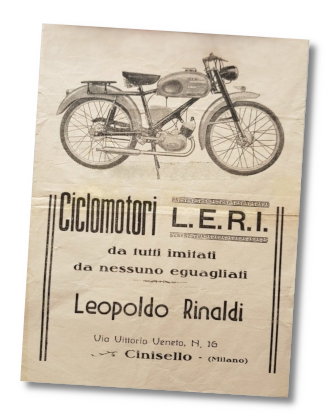
1950s’ Le.Ri moped leaflet
Following the interruption of a couple of wet and windy days, we prepare the bike again for the official paced road test. Our pacer is already waiting while we start the Demm engine, which readily fires up after a couple of presses on the carb ‘primer’, then we leave it running a while to warm the engine otherwise it fades on throttle if tried prematurely. Mount up and easily pull away again at low revs, the motor again displaying its torque. Trickle down the drive and onto the road, then ease back down in second to turn at the roundabout instead of expecting much help from the braking capabilities. The engine pulls gently and smoothly in second gear, which feels docile and capable for about town use into the low 20s, and you generally find the natural change-up point to third around 25mph.
Top gear gives the impression that it’s a high ratio, because winding back the throttle creates a muffled intake draw through the air filter, though the speed only gradually creeps up to a paced maximum of 32mph on the flat in still air. This performance isn’t really a surprise considering the low power rating of 1.5bhp with a low 6:1 compression ratio. Typically, similar period Italian three-speed models tended to be over-geared in top in relation to their motor power, and generally only obtained their top speeds on a downhill run or with a strong tailwind, but a three-speed Minarelli engine would produce over twice the power, so we’re really not expecting our Demm motor to be comparable in performance.
Covering several on-flat sections only returns the same 30–32 results again, but running into the first short downhill section the speed picks up to a paced 34mph, though also drops away again against the following light incline. On the next longer light downhill section, it manages a paced 35mph, but our 68-year-old Demm engine obviously has nothing more to give, so might be getting due for an overhaul to perk it up again.
The suspension at both ends worked fine, though the steering did prove light and twitchy while glancing over your shoulder to look behind. The Le.Ri was an interesting and unusual bike to ride, which could have been improved by a more powerful engine and more effective braking.
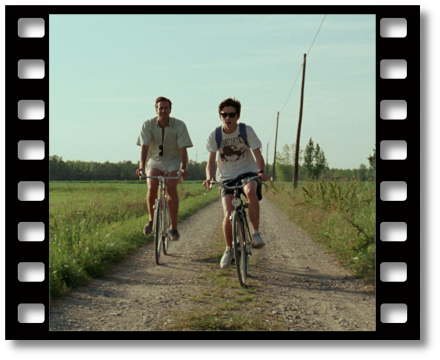
Leri bicycles in ‘Call me by your name’
The Le.Ri business moved to Muggio in Monza and Brianza Province in 1958, where sons John & Rosina continued selling the handcrafted production of bicycles and expanded the range of products with a selection of cycle accessories.
The company began selling internationally with deliveries of racing cycles to America in 1970, and further began production of compact folding cycles. In the 1980s, both mountain bikes and BMX acrobatic bikes were introduced, boldly finished in all sorts of vivid colours.
In 1992 and 2001, the daughters Paola and Roberta joined the company to make the fourth generation engaged in the family business. In 1998 Leri celebrated 100 years of trading by inviting regular clients to a special exhibition event.
Leri bicycles were featured in the film ‘Call me by your name’ by Luca Guadagnino, which won an Oscar for best-adapted screenplay in 2018.
Now, after 128 years, the company still continues selling bicycles, electric bikes, and accessories from Via Varese 2, 20835 Muggio (MB) Italy. Website: www.leribiciclette.it