Introduction
Iceni CAM Magazine
This is the home of the Iceni CAM Magazine—a
free e-magazine about Cyclemotors, Autocycles, Mopeds … and
more. It was launched on 15 April 2007 and the most recent ten issues
can be downloaded here. All the articles from all the previous magazines are on
this website. For non-computerised folks, printed copies are
available at £1.50 per edition; we can accommodate mail order too at £3.02
for single edition or £12.20 for a year’s subscription.
So what’s it about?
It’s an e-magazine all about cyclemotors, autocycles and mopeds that
carries road test & feature articles, rally reports, free adverts and other
assorted information. Although we are an independent production, we
have strong ties to the EACC and also to the New
Zealand Cyclaid Register.
We are based in East Anglia, but are by no means limited to that
area. Much that appears in the magazine is of universal appeal.
We welcome contributions, wherever they are from, and are also happy to
help to publicise any events for cyclemotors, autocycles and mopeds.
When’s it published?
We try to publish four times a year at the beginning of January, April,
July, and October—and things nearlyalways work out that way.
Iceni CAM is purely an enthusiast production, and all produced on a
tiny budget. The free downloadable version will be posted on this
website on the same day as the printed version goes on sale.
All the issues of CAM Magazine that we’ve produced have been very well
received. Thank you all for your comments; they are much
appreciated. Several of you have also made donations, which has
helped enormously in keeping Iceni CAM going.
What’s in it?
The May 2026 edition is available now on our Downloads Page.
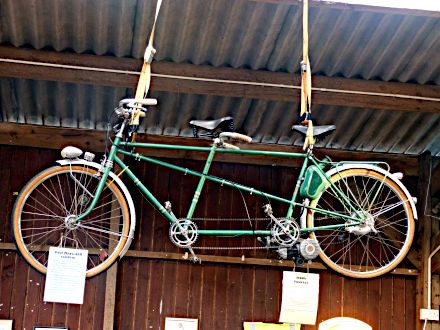
The tandem on the EACC stand
at the 2013 Copdock Show
The Paul Maye–SER tandem had been lurking
around in the Suffolk Section background for several years, and appeared on
a number of occasions in section note dispatches on local club runs and at
shows. Such a characterful machine was obviously a likely candidate
for one of our articles someday—and that day is finally here!
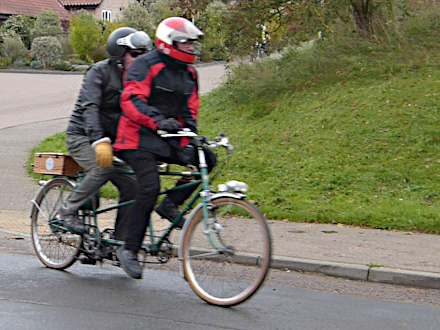
Team Tandem in action at Kneels Wheels in 2023
It’s a machine of great character and often attracts a fair amount of
interest when it turns up at events, as you really don’t see many motorised
tandems. Tucked away beneath the rear bottom bracket, the SER Itom-licensed
engine is barely noticeable and practically disappears against the sheer
physical size of the tandem frame.
Team Tandem are Suffolk-based Martin Kendall
and Nick Parker, who completed reconstruction of the bike and its
registration for use in local run events—because realistically, this isn’t
the sort of thing you’re going to be using for conveniently popping to your
local supermarket…
As regards producing the article, neither the Paul Maye cycle frame or
the SER engine are things you’ll even find in mainstream motor cycle
reference material, so all the research is a deep dive into obscure French
references, requiring translation in every case. Any information that
can be found is generally only partial passages, and it requires several
such scraps collated from different sources to start building up the
stories, then eventually a picture begins to form.
The tandem article was planned before our previous edition, but the
photo-shoot was delayed until 18 March due to the extended wet
weather. That shouldn’t have been much of a problem since the article
could be worked on in the meantime, except when two consecutive major
computer breakdowns prevented access to the text file for six weeks.
We did get there in the end, but a month late getting to press.
Sponsored by David Osborn, Cambridgeshire EACC.
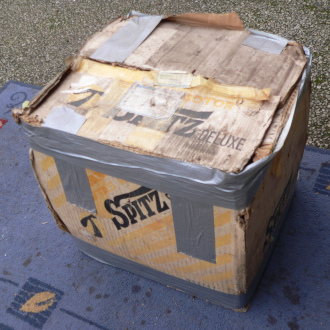
Our Tanaka engine came in its original box,
new and never used—for around 43 years, and long enough that the ink on the
box labels had faded into obscurity! We’d had the boxed engine in our
possession for probably some 15–20 years, and long enough even to forget
where it actually came from. The most likely options came down to
either having bought it in among some job-lot of parts, or Paul having
picked it up at a car boot sale—we’ll never really know.
The TAS Spitz box just got put into a plastic storage bin, stashed away
on a shelf in one of the stores, and pretty much forgotten about. As
the stores were reorganised following our site move, the engine resurfaced
and, as a number of other bikes were restored and cleared over the last few
years, a plan to build the Tanaka on to the Raleigh R20 Solitaire was
hatched as an over winter project and put into action over Christmas
2025. It was confidently planned in as a feature for our second
edition of 2026 before main issues with the drive roller and engine were
discovered, though quickly resolved, and assembly completed for first
photo-shoot with pictures for registration by the third week of
January.
The bugs were debugged and road tests completed the following week and
notes largely written up over the following week, before the first major
computer breakdown prevented further access to the text files, until the
technical issues finally got sorted out six weeks later…
Our Tanaka QBM-23N had a ride to the Jawa road tests & photo-shoots in
Northampton on 24 February to appear in some comparison pictures
together with Stuart Austin’s earlier QBM-23 BikeBug on a Hercules
bicycle.
The registration came through; the bike was advertised, sold and gone,
even before the article reached publication, making workshop way for other
projects.
Sponsored by Paul Clipstone, Ipswich, as thanks for original
registration recovery.
Second Support feature: Pointless
We didn’t have anything planned for the third
article at the time our last magazine came out, so that just got notified
as ‘something will turn up’, subsequent to which Tony Austin came to the
rescue with an offer of both the type-28 and type-207 Jawa mopeds for our
‘instant, just add boiling water’ Pointless feature.

Both these are now both old and rarely seen early Babettas: the M-28
being 53 years old, and the M-207 being 49, so both now classified as
historic vehicles.
The quality of these earlier Jawa models built at Považské Strojárne was
pretty good, but Babetta moped assembly was transferred to the plant at
Kolárovo in the south of Slovakia from 1976, then later to its new
auxiliary plant in Čalovo, close to the Hungarian border. The build quality
suffered, and suffered again with each of these moves, with the subsequent
210 models developing a poor reputation.
With larger 12mm carbs and higher 9:1 compression ratio giving 30mph+
performance, the 210 models certainly perform a little better than the
40km/h, sub-25mph earlier types, which generally prove quite slow and
disappointing to ride and struggle to keep up with the usual pace at club
events today.
The trip to Northampton on 24 February to road test and photo-shoot
Tony’s Jawas further worked out for the Tanaka article, since brother
Stuart also had an early TAS to give us comparative pictures for the
BikeBug feature.
Sponsored by ‘Big’ John Berry, Ipswich, in appreciation of a dating
certificate for registration.
What’s Next?
The next magazine is scheduled for publication in September
2026.
Next Main Feature: ‘Well gentlemen, the company has called this
meeting because of the autocycle sales we’re increasingly losing to trendy
Italian scooters, and the business needs to react. Our best designers
are already hard at work on new designs which will very shortly be going
into production, and will have the likes of Lambretta and Vespa quaking in
their boots! We can show these Latino chappies that British industry
knows all about styling too.’
What were they thinking?
Next First Support: SR2E? Isn’t that some old jet
aircraft? No, that was the TSR-2. So what’s this?
Well, it seems that it’s a late 1950s’ East German moped that was never
sold in the UK, even though the ‘E’ tells us it was an export model.
This must have been one that escaped over the wall…
Next Second Support: Again we have nothing lined up yet for the
third slot in our next edition, but hopefully again, something will turn
up…
What else?
Well, there’s this Website … we’ve put a lot of useful information
here, and we’re alwas adding to it. We have a directory of useful people to know. Information on
local events and, after each run, we put photos of the event on this website. There’s
also a market place where you can buy and sell
mopeds, autocycles, cyclemotors and other related items

As each edition of the magazine is published, we add to our collection
of articles. From Edition 3 of the
magazine, we introduced another evolution. Previously, features in
the articles section had reflected what
appeared in the magazine, but you may now discover a bit of extra content
has crept into some items as they’ve transferred to the website—you might
call it ‘The Directors Cut’. The problem with printed magazines is
editing everything to fit page sizes and space, and there can sometimes be
bits you’d like to include, but they have to be left out to fit the
available space. The web articles don’t need to be constrained by the
same limitations so, although the text will remain the same, the ‘Directors
Cut’ graphic in the header indicates the item carries extra pictures and
bits that didn’t make it to the magazine.
We also have an Information Service—if you want
to know more about your moped, we can help.
What we do
Iceni CAM Magazine is committed to celebrating
all that’s good about the Cyclemotor, Moped and Autocycle scene;
researching toward the advancement of the pool of knowledge about
cyclemotors, autocycles, old mopeds, and other oddities; and the
publication of original material. We are a declared non-profit making
production, though we still need to fund everything somehow to keep the
show on the road.
The magazine is free on line, and the nominal price of supplying hard
copies to non-computerised folks is pitched only to cover printing and
postage. All advertising is free since we believe that the few people left out there providing parts & service for
these obsolete machines do so as a hobby and an interest. This
involves far more effort than reward, and they should be appreciated for
the assistance they provide. Our Information
Service is there to help anyone needing manuals to help with
restoration of a machine. We make a small charge for this but, again,
we have set our prices so the just cover postage and material costs.
However, we are trying to make this free too! We are setting up an
on-line library where you can download
manuals at no charge.
Overheads involve operation of the website, and particularly the
generation of features. Articles like Last Flight of the Eagle can cost as little as £20 to
complete, while others have cost up to £150 to generate, eg: Top Cat on
the Leopard Bobby. With these overheads, you may be wondering how we
get the money to keep it all going. So do we! But, somehow, it
works, helped by a number of generous people who have sponsored articles or
made donations to keep the show on the
road.
How long does it take to research, produce, and get these feature
articles to press? Well, up to two years of preparatory research in
some cases, where little is known about the machine or its makers, and
where nothing has been published before. Then, collating all the
information and interviews, drafting and re-drafting the text, travel and
photoshoots typically account for up to 40 to 50 hours to deliver the
package to editing.
There are many examples where these articles have become the definitive
reference material for previously unpublished machines like:
Ambassador Moped,
Dunkley Whippet & Popular,
Elswick
Hopper Lynx,
Leopard Bobby,
Mercury Mercette & Hermes,
Ostler Mini-Auto,
Raleigh
Ireland Super,
Stella
Minibike,
…and many others.
We’re committed to continuing to produce these articles, because we
believe it needs to be done, and we’ve got a proven track record for
achieving it. Nobody else has done it in 50 odd years, so if we don’t
do it—who will?
To whet your appetite for what’s ahead, here’s an updated
list of machines with developing articles for future features:
Ariel Pixie;
Beretta–Mosquito;
Capriolo 75 Turismo Veloce;
Cyc-Auto (Wallington Butt) & Cyc-Auto (Villiers);
Dunkley S65 & Whippet Super Sports;
Elswick–Hopper VAP MIRA test prototype;
Gilera RS50;
Hercules Her-cu-motor;
Honda Gyro Canopy, Model A, CD50, & SS50;
James Comet 1F;
MV Agusta Liberty;
Norman Nippy Mark 3;
Powell Joybike;
Rabeneick Binetta;
Simson SR2E;
Solifer Speed;
Sun Autocycle & Motorette;
Vincent Firefly;
The working list changes all the time as articles are completed and
published, and further new machines become added—so as you see, there’s
certainly no shortage of material.
Readers have probably noticed a number of the articles collecting
sponsorship credits, and we’re very grateful for the donations people have
made toward IceniCAM, which certainly assures we’re going forward into
another year. We don’t need a lot of money since IceniCAM is a
declared non-profit making organisation, and operates on a shoestring (and
we’d like to keep it that way)—run by enthusiasts, for enthusiasts.
It’s easy to sponsor an article by either picking a machine from the
forward list, and we’ll attach your credit to it, or simply making a
donation. There is no fixed amount, it’s entirely up to you, and
however large or small, we’re grateful for any contribution to keep the
show on the road.
If a vehicle you’re interested in seeing an article about isn’t in the
list, then let us know and we’ll see about trying to add it in the
programme, but we do need access to examples—perhaps you have a machine
you’d like to offer for a feature?
See the Contact Page for how to: Sponsor an article–Enter a free advert–Submit an article yourself–Write a letter to us–Propose a machine for feature–Offer your machine for test feature …
News
Sorry we’re late
23 April 2026
You might have noticed that we failed to make our expected early April
publication date, due to several factors: two consecutive major computer
breakdowns prevented access to article text files for over a month, and 3
more weeks working time were lost to seasonal illness. An additional
issue was that when we published our last magazine in January, we had no
planned article for the third feature slot, which was advised as ‘something
will turn up″. The reason for this was that we’d run out of available
machines for an article, but we″ve now secured machines to present this
third feature as ‘The electronic age finally catches up with the humble
moped, but is it just “Pointless”?’
We’re catching up on the writing and are now expecting to be publishing
our next magazine about a month late, towards mid-May. This, however,
would compress the usual three-month time frame to meet our following July
deadline and, at present, we still have the issue of insufficient machines
to fill the available article slots.
Since we can’t catch up on the lost time, we’ve decided to reduce this
year″s IceniCAM magazines to three issues at four month intervals.
The edition after May will be scheduled for mid-September, with the
subsequent edition returning to the usual pattern of January 2027.
Hopefully by this time we might have caught up on our lack of machines
to feature and return to our usual cycle of 4-issues for 2027 … but we do
need bikes, and would appreciate if anyone might be able to offer a machine
we haven’t covered yet, and would be interested in.
‘Just a minute,’ you may be thinking ‘what about those machines you have
listed for future features?’ Yes, we have those, but they will need
work doing, in some cases a considerable amount of work doing, before we
can hope to do a road test.
Please use our Contact us
page if you have a bike we could feature.
More Old Photos
11 April 2026
Another batch of photos from the archive, this time from the from the
Coast to Coast Run in June
2005.
Old Photos
29 March 2026
We’ve been going through the archives again and found some more old
photos; these are from the First
Norfolk East Coast Run back in November 1989.
23 March 2026
After a fortnight’s work, we″ve rebuilt the Ariel 3
Register website on Iceni CAM. Although converted to match the
style of the rest of Iceni CAM, it contains all the photos and even has the
original background ‘wallpaper’, which we retrieved using the Wayback Machine. We have
also constructed a database of Ariel 3s, though some of the data was lost
when the original register closed down. Nevertheless, we have been
able to supply the EACC’s Machine Dating service with some extra
information.
9 March 2026
Once upon a time there was an Ariel Three register with a website and
everything, but when the webmaster decided he could not keep it maintained
any longer he could find no one to take it over—so it disappeared.
Not being Ariel Three owners ourselves, this event passed us by
somewhat. However, we’ve found out now. Paul Bottomley has
kindly provided us with most of the files, including all the photos needed
to get the website bit hosted. It shows loads of Ariel Threes listed
in alphabetical order of registration. We’re putting it back together
a letter at a time and, at the time of writing this (9 March), we've got as
far as ‘F’. You can check on our progress here….
There were also some original documents in the information Paul sent us;
we’ve added these to our on-line library.
Digital Banbury
13 January 2026
Dear IceniCAM,
The Banbury Run is a super event: 100-year-old
bikes ridden by like-minded individuals (some look as old as the bikes) and
superb scenery, but entries have been falling
and the VMCC has employed outside consultants to assess the event (no doubt
these consultants all ride belt-drive veterans on a daily basis!) As
a result of this, it’s all going digital! Entries will only be by on-line forms from
now on.
I’m Seedy (Sufferer from Egregious
Digital Illiteracy, or S.E.D.I.) and am therefore excluded from
all future events as, I suspect, many others will be too.
I can well understand the attempt to attract young entrants but they are
likely to alienate many regulars, myself included. Think again VMCC, you can well afford to process paper
applications.
Best wishes,
Geriatricus.
P.S.
Q: Do you have the App?
A: No, I’ve always had a limp.
Older news stories are available in our News Archive