
Takashi Tanaka started business with the foundation his Tanaka Iron Works near Tokyo, Japan in 1917. In 1941 a new manufacturing plant was built near Narashino (approx 25 miles south-east of Tokyo) and, in 1948, Tanaka began research and development of compact internal combustion engines to introduce a ‘BK-3 Featherweight’ bicycle motor in Japan, which was to become the original predecessor of a subsequent series of similar evolving cyclemotors.
In 1950, the company name was changed to Tanaka Kogyo Co, Ltd (Kogyo meaning ‘Industries’ in Japanese).
In 1951, Tanaka began mass production of moped engines, and in 1954 produced and marketed a 125cc motor cycle engine. Concentration on moped and motor cycle engines continued until 1962, when he opened a further plant in Shirako and introduced the world’s smallest industrial, general purpose two-stroke engine (the 22cc P-7). In 1965, Sieken Tanaka (Takashi’s son) became President of the company and began a pursuit toward worldwide markets.
In 1968, Tanaka began marketing 50cc, 60cc, and 100cc motor cycle engines for export to North America. In 1971, it produced a new chainsaw and hedge trimmer for export markets and, in 1974, introduced a 2.5hp air-cooled two-stroke outboard motor, which an ambitious young sales representative by the name of Robert Thomson convinced Simpson Sears (of Canada) to list in the Sears catalogue.
In 1975, Tanaka expanded its production plant in Shirako and began production of a 23cc, 1.2bhp motor for applications in a wide range of powered equipment such as strimmers, brush cutters, hedge cutters, chainsaws, generators, pumps, outboard motors, and cyclemotor kits.
The tiny two-stroke bicycle engine was reportedly evolved from a miniature outboard motor by reducing the prop shaft & housing and replacing the propeller with a rubber-faced drive roller. The advantage of this development was that the engine mounting arrangement allowed the motor to be mounted close to the steering headset, with the shaft extended forward to enable roller engagement with the cycle tyre without any need to cut back the front mudguard.
As the global oil crisis hit the US in 1973, demand for bicycles had surged, but some of these new cyclists didn’t embrace the physical effort of cycling as enthusiastically, and Tanaka’s cyclemotor attachment engine could offer a solution. If everything was perfectly in tune, you could supposedly achieve as much as 300mpg!
By 1975, Sears was listing a selection of Tanaka motorised products including the ‘Free-Spirit’ cyclemotor attachment engine, which was soon extended to Sears Roebuck for sales into the US. As part of the promotion, Sears displayed its own-branded ‘Free Spirit’ bicycle engine at the Sears Tower in Chicago as one of its more ‘interesting’ products.
The motor reportedly became available in 1.2 or 0.8 horsepower variants, and sold under various names: ‘Sears Free Spirit’, ‘TAS Bike-Bug’, ‘Little Devil Brand’, and ‘TAS Spitz’.
Into the late 1970s, Tanaka was also supplying outboard boat motors, small generators, pps, and cyclemotor kits to Aquabug International, a small mail-order distributor out of New York State, with the cyclemotors from Aquabug being sold under the ‘Bike-Bug’ name. Tanaka’s distribution warehouse had an archive of these products and they were all based on the same ‘23’ motor, just being fitted with a different housings to adapt to whatever intended purpose.
In 1983, Aquabug International was experiencing financial issues, so Tanaka acquired the distribution company asset value to maintain its sales into the eastern US states under the name of ‘Sporting Edge’ Tanaka North America, then dropped the Aquabug and Bike Bug monikers, to continue selling the bike motors under their brand name ‘TAS Spitz’. ‘TAS’ was a name that Tanaka had been using on its recreational vehicle motors since the sixties: the mini-bike, motor cycle, and moped engines.
The QBM-23 Bike-Bug motors were described as a single cylinder 23cc, two-stroke engine achieving 0.8hp @ 6000rpm. The bore and stroke of this unit is given as 30×30mm, which calculates out to 21.2cc, so actually a little short of the ‘implied’ 23cc. The engine compression ratio is given as 7.2:1, and uses a serrated rubber surfaced drive roller against the front tyre to propel the bike.
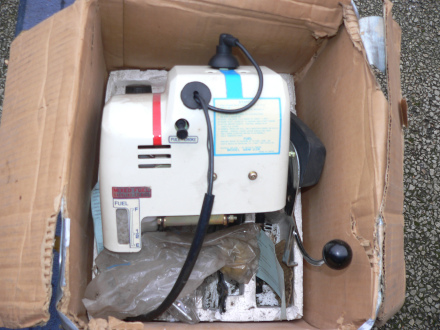
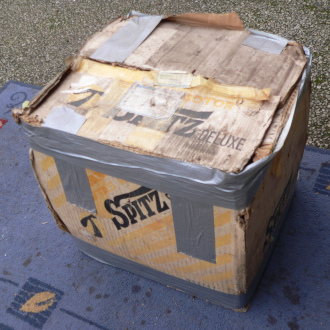
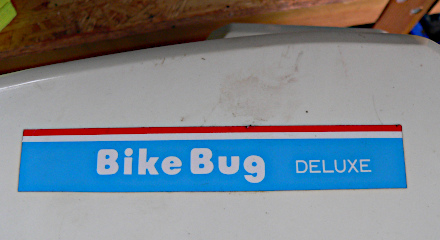
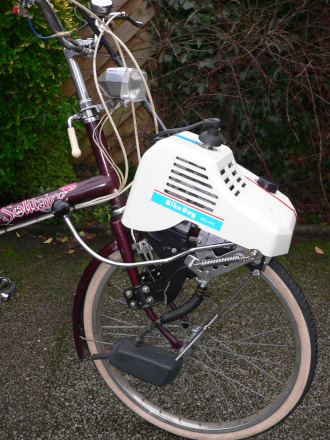
Our particular Tanaka engine came brand new, never run, and still in its original box printed outside ‘T Spitz’, though inside were Aquabug Ltd guarantee & warranty cards, on which basis the motor was dated to 1983. The engine is fitted with a plastic cover fixed over the motor by screws to hold it down at five points to mounting points on the frame beneath, with a factory sticker on the back of the cover indicating this as a QBM-23N Deluxe model, and further side decals of ‘Bike Bug deluxe’.
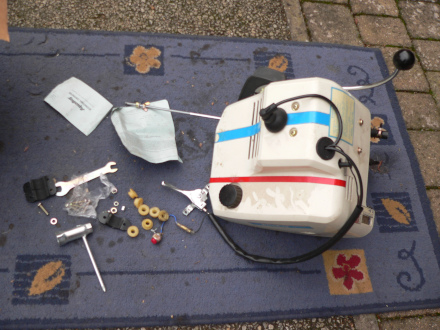
Examining the box contents confirms that just a rubber clamping strip is missing from one engine mounting, nothing that can’t be improvised … but our new engine is also nearly 45 years old, and it’s best to check for any potential issues before mounting it on a cycle. There seemed to be a number of crumbly rubber ‘chippings’ in the polstyrene bottom packing when we lifted the engine out, so where have they come from? Flipping over the engine, it looks as if the rubber covering is completely crumbling away from the roller, so we cut and bond a new rubber sleeve to the aluminium core to restore the drive roller, and adjust the gap to the tyre at 5mm as recommended in the manual.
Full throttle?
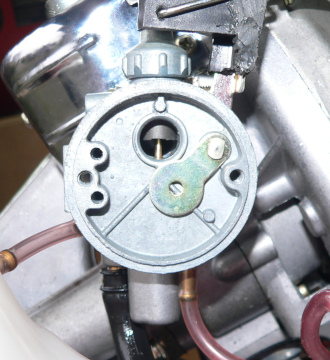
We also find the linkage is broken on the choke connection, fixed by plastic welding, after which we further discover the air filter has literally disolved, so cut another from a sponge washpad. A point to note however, is that, while working on the motor we happened to remove the carburettor slide top to investigate the apparently limited operational range of the throttle lever, and we found a floating machined brass collar fitted above the air slide that restricted the throttle opening in the 12mm venturi to just about half! Odd? We replace the slide top with the collar still in place, and will come back to that later.
Now we’ve got the engine mounted, we can check it for a spark, so take out the plug, put it in the cap with an earth wire clipped to the plug body, engage the roller and walk it down the drive—no spark, nothing … Stripping out the mag-set finds a massive 125MΩ resistance across the closed contacts, so we run some wet & dry through the contacts and a remeasure finds 0.2Ω now, so that’s fixed the points, and since we’re in there, we check the original capacitor, which tests as down on electrical performance, so we fit a new one.
Rebuild the motor, retest, and we now have a spark.
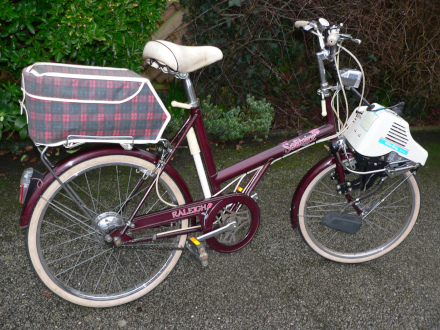
The engine however, is only half the story of our cyclemotor, there’s also the bicycle it’s mounted on, which in this case is a Raleigh R20 ‘Solitaire’ with date stamping on the three-speed Sturmey–Archer Dynohub indicating 1.80, and the frame further dated as manufactured September 1980 from the factory serial stamped on the back of the saddle stem. This bike was specifically chosen because it was a popular cycle of the period and had a similar dating to the engine.
The Raleigh R20 Shopper was a small 20-inch-wheeled bicycle made by Raleigh from 1968 into the 1980s, produced in both fixed frame and folding versions, and created in response to the Dawes Kingpin, which had been achieving market popularity since 1964.
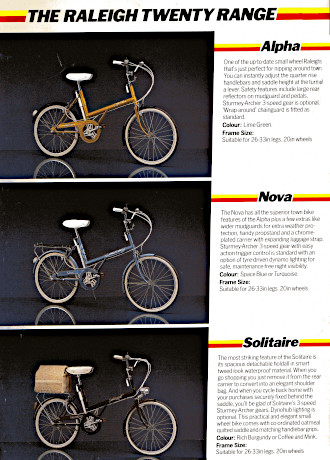
The ‘Twenty’ was only gently marketed when it was first introduced in 1968 as a companion model to the RSW16, which had been Raleigh’s competitor model to the Moulton since 1965, until Raleigh bought out Moulton in 1967. By 1970 the RSW16 was well into its sales slide, so Raleigh decided to market the Twenty more aggressively.
The Twenty subsequently proved a better and more successful bicycle than the Sixteen, its larger diameter and narrower 1⅜" tyres proving smoother to ride and offering less rolling drag than the 2.125" tyres of the 16, which was discontinued in 1974 when the Twenty took over the position as Raleigh’s main small-wheeled production bicycle.
While Raleigh sold some 100,000 RSW16’s over its nine-year lifespan, by comparison, the R20 manufactured 140,000 in just 1975, for the UK market alone! It became Raleigh’s biggest selling model in 1977, though sales began to taper away after this. The ‘20’ continued into 1984, giving 16 years of production.
Our Solitaire has a three-speed Sturmey–Archer Dynohub to power the cycle lighting set, which is switched on–off beneath the headlamp. The three-speed trigger and bell are mounted on the left bar, since the throttle lever and kill button are mounted on the right.
Selecting second gear seems better for starting up as it reduces the effort required but, following a pathetic first trial attempt where the motor wouldn’t even run without choke because the main jet was seemingly blocked,we have another go following a carburettor service.
Our second attempt was more worth a report, and we’re learning about this machine as we go. There’s no fuel tap on the Tanaka engine, which seems to have some sort of diaphragm pump arrangement in the bottom of the engine to lift fuel from the tank to the carburettor, but you still have to activate the system with three presses on the primer bulb. Choke is required, so pull out the knob to start. You can’t start with the engine drive pre-engaged since it proves too difficult to pedal past the compression from a standstill, so you have to pedal away to build up speed before engaging the drive lever to ‘shock’ the motor into turning over, since the motor doesn’t have a decompressor.
We find one of the issues with this method is that the tyre can slip against the drive roller, sometimes requiring additional hand pressure applied to the ball on the engagement lever, but at this stage we haven’t yet perfected the best starting technique.
The tiny engine doesn’t put up much resistance once you’ve got it turning, and tweaking the throttle, the motor gently putters into life. Ease along with partial throttle, reach forward to push off the choke, then open the throttle lever, and the motor responds. On slow running setting with the drive disengaged, the motor purrs quietly. This slow running setting was how the carb adjustment came on this new motor, and a little higher than tickover, which we noted was enough to allow the bike to crawl along without stalling on closed throttle. Just reach down with your right hand and disengage the drive lever if you want to stop with the engine running, so it operates like a latching clutch lever.
The engine now responds to choke free throttle, and once warmed up, pulls the bike adequately enough on the flat. It’s very noticeable that the motor slows against the slightest inclines, and readily runs ahead on the down side, but these aren’t hills, they’re just bumps along the road—because that’s how things go in 20cc world!
On the return leg we open the throttle full, the motor now feels to be powering up its revs, and feeling like it’s ready for a proper paced run … until the roller starts slipping, which seems possible since the road is damp and it could be picking up some water … and just turning back into the drive—we realise the front tyre has gone flat … Oh, *¥!ﻈ#ǿ!
Our reconstructed drive roller is smoother with just shallow slots, and not so aggressively ‘toothed’ as the original roller. Maybe it’s more prone to slip, so we reduce the adjustment gap of the roller to the tyre down to 2mm for better drive engagement, and blow the roller and tyre dry again with the air compressor.
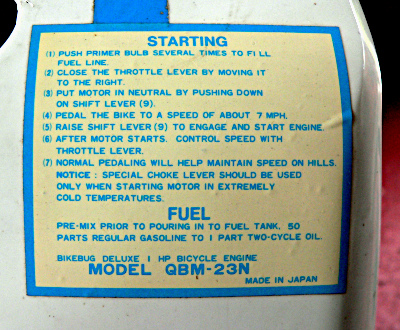
Having already been run once down the road and back, the motor seems to have settled down to starting and running fairly well, the puncture is fixed, and now we’re on for our first paced road test. Standard starting procedure is: press the ball primer three times, pull on the choke knob, pedal down the drive and engage the lever to start, push off the choke, then sit warming up the engine while our pacer readies.
Our Tanaka enthusiastically hums along this time, though still seems sensitive to minor undulations in the road, and now paces at a best of 17mph.
So, back to that 6mm brass limiter collar above the throttle slide. Our researches seem to explain this, as a 20mph limit was applied to motorised cycles in several US states, (Virginia, both Carolinas, Texas, Ohio, Michigan). Other US states were variously specified to 25mph or 30mph, though New York State was restricted to just 17mph.
It was our presumption that the same 12mm carburettor was fitted to all engines, and maybe restricted in performance by fitment of a collar as required according to the respective US state it was being sold in.
We’re now convinced that the collar is functionally unnecessary and serves no other purpose than limiting motor performance for sales into specific US states. It’s quick and easy to remove, and the throttle slide now completely clears the venturi when fully open (which makes much more sense), so we’re ready to go again with the full 12mm bore of the carburettor now available.
We’re now getting more familiar with the controls for best operation, and now discover that starting is made easier by engaging the drive to back the motor onto compression, then disengaging the drive, so when you now pedal off and re-engage the drive, the motor starts turning over much more readily. This little trick makes a big difference to easier starting, and with less likelihood of the roller slipping.
With the engine running at low revs out of drive, it works best to just pedal off from a standstill in second gear, engage the motor, then open the throttle lever.
Once underway it was generally better trigger up into third gear as a more effective ratio for pedal assisting the engine if required.
Without the restriction collar is better, because you can open the throttle wider for more power when needed, so you can maintain a better average speed with less tendency to lose pace against light inclines, and less requirement for pedal assistance. The motor buzzed a little more, and best speed on flat now paced at 19mph, but it’s worth remembering that this ‘new’ engine has now only covered no more than five miles, and is likely to find more potential as it runs in. We noted that that the motor ran smoothly until the throttle was fully opened, when it tended to run rough and prevented further speed increase. This appeared a minor carburation imbalance just at the very top end of the throttle range, which might be resolved by fine adjustment of the air slide needle, or may just go away as the engine gets more use. The brakes and lights are bicycle ... well, because it’s on a bicycle...
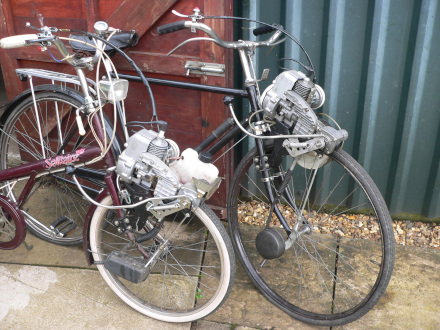
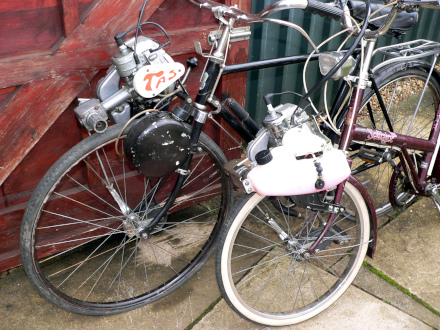
We further happened upon one of the earlier Tanaka QBM-23 cyclemotor engines, mounted on a 26" wheel Hercules bicycle, and this preceding 1970s’ version of the cyclemotor demonstrates an ‘open’ style engine with no cover, ‘TAS’ on a circular steel fuel tank mounted a little lower down on the left-hand side, with the same exhaust (though different silencer), fan-cooled engine and roller drive arrangement. It’s absolutely the same motor, with the same carburettor, and removing the carb top reveals that it too was also fitted with the same brass 6mm limiter collar to restrict the throttle opening!
One observation from an operational point of view, is that the motor sits higher on a larger wheeled bicycle, so you don’t have to reach down as much to operate the drive engagement lever.
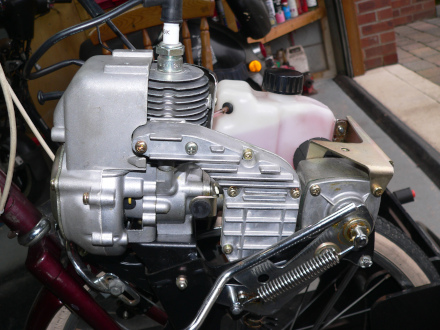
The 1980s’ QBM-23N seemed to be the last iteration of the Tanaka cyclemotor engine, and characterised primarily by its plastic engine cover. Removing five screws to lift off the cover, reveals the fan-cooled engine, a plastic blow-moulded fuel tank, finned cast aluminium exhaust, and the roller drive arrangement.
Since earlier models were reported as rated 1.6bhp@7,000rpm, compared to the later 0.8bhp@6,000rpm engines, this does make you wonder?
There’s no question that these figures relate to the same ‘23’ engines with the same 12mm carburettor, and it might seem a little unusual to de-tune what appears to be the same motor by 50% – unless US state legislation required this to comply with performance specifications.
It seems fair to accept that the same motor might produce higher power at higher revs if the throttle opening was doubled ... and seems pretty likely that the limiter collar was fitted to restrict the motor capabilities from 1.6bhp rating, down to 0.8bhp, to comply with 17 & 20mph specifications.
The brass limiter collar serves no functional purpose, so simply remove it to increase performance, and with only a 21cc motor, you’re definitely going to be grateful of 50% power increase.
The Tanaka cyclemotors were never officially marketed in the UK, and the few examples found here represent just grey imports that have found their way across from the American market, and may have even been shipped direct from Aquabug to UK customers, since they were primarily a mail order business, and presumably the restriction collars were just simply fitted into all motors.
So what happened to the TAS Spitz bike motors?
By the late 1970s a moped boom in the USA had already begun, and the writing was already on the wall for the second generation cyclemotor. Now you could buy a moped for little more than the cost of a bicycle and cyclemotor kit, and instead get a complete assembled machine, that was more substantially constructed, faster, more comfortable, and with better brakes.
Sales of the Tanaka cyclemotor engines fizzled out very quickly into the mid 1980s, so dramatically in fact that retailers found themselves stuck with unsold stocks which they struggled to clear despite increasing discounts, until finally being faced with having to dispose of them at a loss.
Tanaka continued with its activity in other market products of two-stroke powered, handheld, outdoor power equipment, and a customer base including both domestic and trade users.
In May of 2007, Hitachi Koki Co Ltd of Japan acquired Tanaka and created two new companies: Nikko Tanaka Engineering Co Ltd to conduct manufacturing and domestic sales in Japan and Nikko Tanaka Engineering USA Ltd, to conduct North American sales and support, based in Auburn, Washington State.
By January 2009, the business functions of Nikko Tanaka Engineering USA were fully absorbed as a brand within Hitachi Koki Co Ltd’s North American division.
In 2021, Koki holdings ceased manufacturing of all two-stroke engine products, thus ending production of all Tanaka products.