
Paul Maye was born on 19 August 1913 at Bayonne, France, started his cycle racing career competing in the French national amateur road race championships in 1934, and in 1935 competed in the French national military and national road race championships. He became a professional cycle road racer in 1936, before joining professional road race teams Armor 1936–37, Alcyon 1938–47, Dilecta 1948–49, and Mervil 1950.
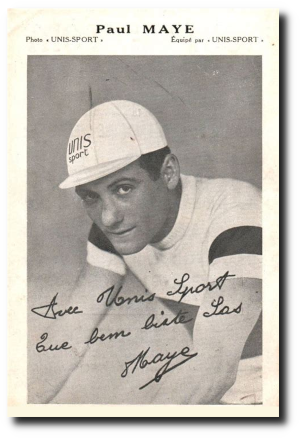
After an exceptional career as a professional cyclist, Paul Maye appeared to switch to team management: for Dilecta in 1949, then Mervil in 1950, after which he seemed to retire from competition, and maybe rest on his laurels as he shared the then record of three Paris-Tours victories.
So what after 1950? Might Paul Maye have gone into making his own cycles? Well, he did run a cycle shop for a brief period. but manufacturing? Maybe not. Often the big French cycle frame builders would produce badged machines licensed under the names of famous Tour de France riders. And it does seem that Paul Maye branded cycles were actually made by Mervil at Pontarlier in the Doubs département of the Bourgogne–Franche–Comté region of eastern France.
The Mervil brand was created in 1941 from a partnership between the Maire and Vuillemin families; as a combination of the two surnames. Mervil grew rapidly, and by 1948 was producing 3,000 bicycles per month. The company readily invested in cycle racing as a means of promotion: firstly by sponsoring a team of amateur riders before turning to professionals, with the increasingly popular interest in cycling sport endorsing the brand’s reputation.
Mervil was not just limited to a sporting clientele, as it also invested in the booming cycle touring sector, which had significantly increased in popularity in France since the introduction of paid holidays in 1936. Men and women alike adopted cycling en masse, and Mervil met this demand by providing specially equipped bicycles during the inter-war period, when cycling became adopted as a symbol for freedom.
In 1949, Maire and Vuillemin established their Mervil Franche–Comté cycle racing team composed of independent riders, managed by Paul Rossier from Peugeot, and the season secured a bag of successes.
For the 1950 season, the Mervil team was re-staffed with high-level professional riders, and management entrusted to Bayonne champion, Paul Maye. Noted for his brilliance in sprint finishes, he was described as one of the best French road racers of the 1930s and ’40s, and Mervil further understood the advantage of linking its name to a celebrated cyclist. During 1950, a Mervil Paul Maye factory was opened in Bordeaux, while the team clocked up numerous racing successes.
Mervil met the demand for cycles such as the ‘Diffu’ (a touring bike) and the ‘Franche–Comté’ (an ultra-light touring bike), and designed two bicycle ranges for competition: one for amateurs, and the ‘Perfection’ series for professionals, built with extra-strong lightweight Vitus tube frames, extra-light tubular tyres, and a low-profile crank-set to maximize speed.
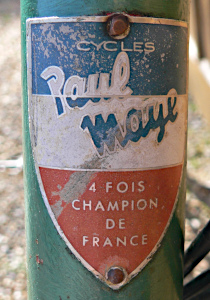
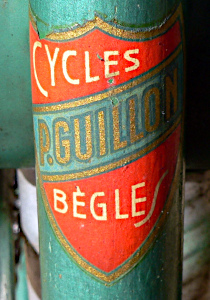
Our particular cycle displays a Paul Maye badge on the headstock, and wears a dealer transfer from P Guillon in Bègles: an long established cycle & motor cycle dealer at 56 cours Victor Hugo, 33130 Bègles. French company records indicate the Guillon dealership as established on 1 January 1900, which seems like a ‘made-up’ date that really means it was probably established before the company registration system was set up. The business was registered to Madame P Guillon. Bègles is an area of Bordeaux, so it seems likely that this bike was made in the works that Mervil set up in Bordeaux in 1950.
Mervil’s main factory was at Pontarlier in eastern France near the Swiss border, while the Paul Maye–Mervil factory was in Bordeaux in the far south western part of the country near the Spanish border.
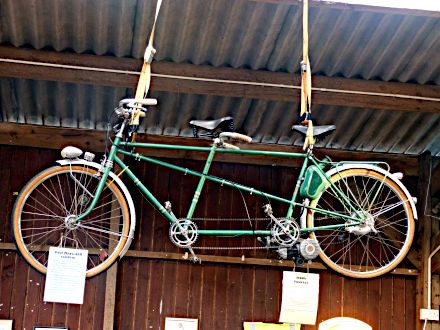
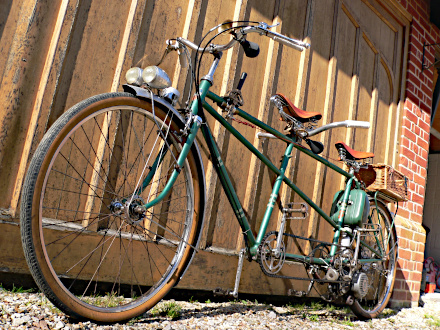
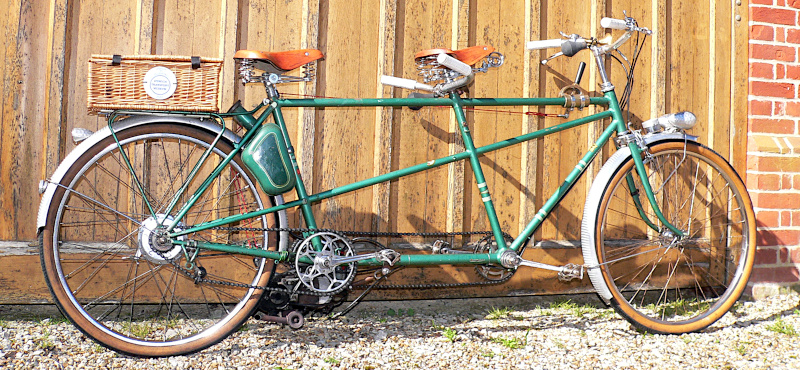
Having a 170cm (67" or 5' 7") wheelbase and a 237cm (93¼" or 7' 9¼") total length, our featured machine is by far the longest bike we’ve ever tested, and why is it so enormous?
Well, that’s because it’s a touring tandem, and it’s also fitted with an engine!
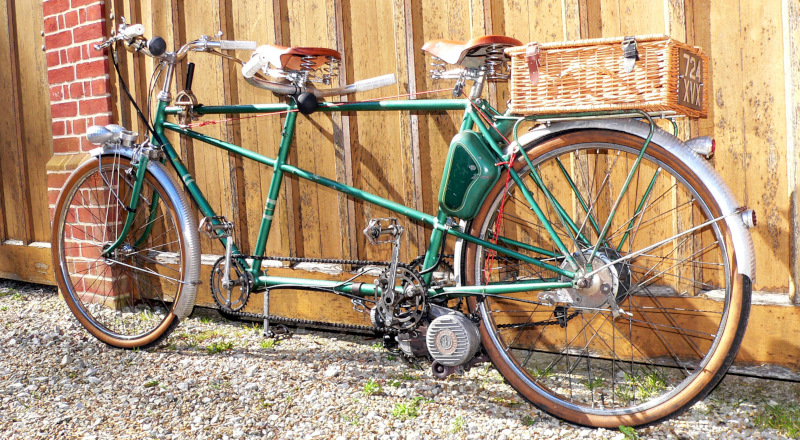
The SER engine is a French-built licensed copy of the Italian Itom Tourist cyclemotor, and is fitted with an unmarked mag-set having only ‘18568’ engraved on the flywheel (which is presumably just the mag-set number). It’s definitely not the usual Italian Dansi mag-set that we’d normally expect to find on an Itom, so we can only conclude that SER might have made its own mag-set.
The background of the SER company takes some working out—founded in 1938, Ets L Sérouge originally produced tooling, machine tools, aeronautical parts, and electric pumps. The need or desire to diversify the products he manufactured led Louis Sérouge to acquire two fully developed and immediately feasible engine technical study designs from Etienne Lepicard, which SER seemingly put into production from 1951. The ‘Lepicard’ LP1 49cc and LP2 65cc single-speed and two-speed were made until 1956.
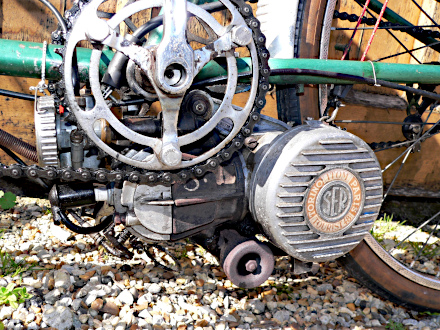
The SER licence-built Itom engine was produced from the end of 1954 until 1957, and was reportedly manufactured by the AMMO Company from another Louis Sérouge Company address given as 138, rue Aristide-Briand, Levallois-Perret, Hauts-de-Seine (only a couple of blocks away from the earlier address).
According to some theories, SER stands for ‘Serious, Economical, Rapid’ which in French would be ‘Sérieux, Economique, Rapide’, so that may be possible but, alternatively, it may just be the beginning of the name Sérouge.
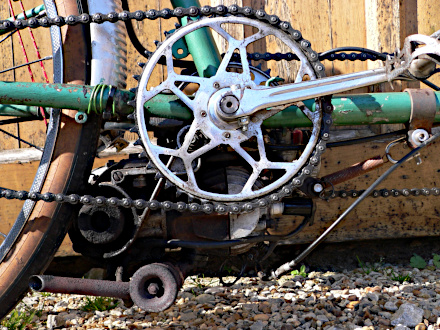
The roller-drive ‘Tourist’ two-stroke motor with an iron cylinder and an alloy piston & cylinder head is given as 39mm bore × 40mm stroke for 48cc, and rated 0.7bhp at a lowly 3,000rpm, though it could be claimed to produce up to 1.4bhp at obviously higher revs. The engine is mounted just behind the bottom bracket by clamping the two lower frame tubes.
The distinctive feature of the Italian Itom engine design lies in its very practical clutch system. A lever, either operated by foot, or hand via connecting rods, normally moves the motor forward to disengage the drive, or returns it to contact with the rear tyre. The clutch system on our tandem however is a little different from both of the standard options. The engine is free-pivoting with a weak spring to pull the motor off engagement, and is moved in to engagement by a brass lever mounted on the forward top tube pulling a cable, with the handle screwed down to lock it into the desired pressure setting. Adapting the cycle to work with the Itom–SER motor requires replacing the left crank arm with one of a greater offset, otherwise the mag-set on the motor will obstruct the pedal arc.
OK, it’s a giant cyclemotor, and we’re really intrigued as to what it weighs, so out with the scales, and here’s the surprise! Front 2st 4lb (14.5kg) & rear 3st 11lb (24kg). This giant is remarkably light at 38.5kg (84.7lb); it’s even lighter than a Phillips P39 moped!
The tandem has a number of 120272 on the left-hand rear wheel dropout, but we don’t know if this frame serial might translate to anything meaningful because it’s difficult to determine any sequence from a sample of one. The only other conclusion might be that the frame serial may simply represent the 120,272nd cycle produced from the Paul Maye–Mervil factory, which would be producing mainly solo as well as some tandem models.
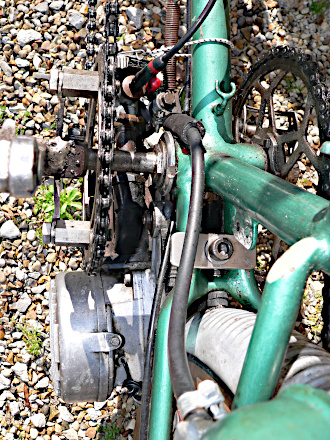
A 1956 dating for this bike is apparently based on the engine number, with the frame dating simply taken to match the engine due to the lack of references, so may not necessarily be the actual date of the frame. When the previous owner acquired the cycle, there was no engine with it, though it did have the fuel tank, rear carrier, and the chain-set already spaced out to clear a bottom bracket mounted engine, indicating it had been previously motorised by some other unknown engine. The SER engine was subsequently acquired to suit, which seemed appropriate as a French motor for a French cycle. The rear carrier is a steel bar fabrication, steel welded, and looks to have been specifically made to clear the tank filler neck, with the tank and rack painted in same matching colours to the frame. We don’t know what its previously fitted cyclemotor engine was, but feel it might have been a Mosquito.
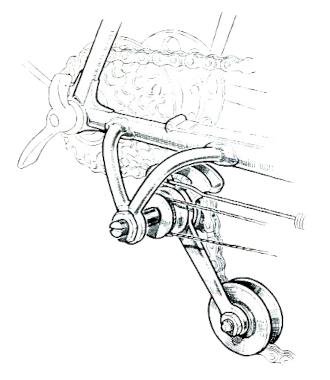
Cyclo Standard derailleur gear
Investigating the tandem frame reveals a number of disused fittings, indicating it was very probably initially built as a cycle tandem with a Cyclo Standard derailleur gear set, which is no longer present.
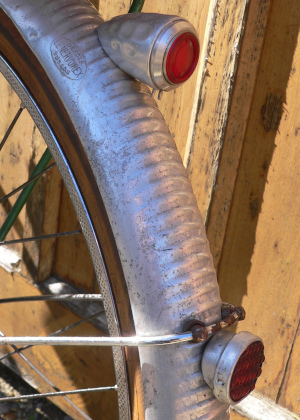
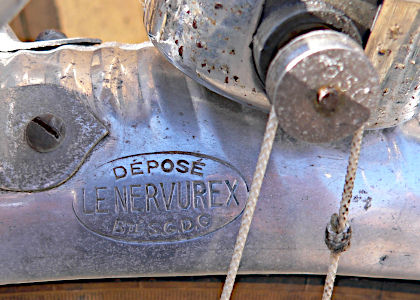
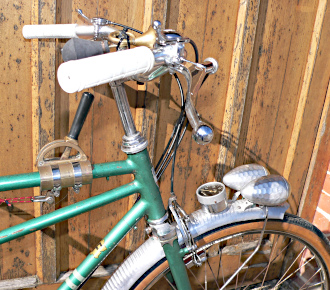
We examine the frame fittings to see if there’s any clues to help our studies: the Le Nerurex aluminium mudguards are interesting for their deep sides and pressed-rib form to presumably improve the rigidity, which does seem to give them improved stiffness, and they do look good. The mudguards are fitted with twin Luxor-65 headlamps with aluminium shells, and there’s a matching alloy shell rear lamp and separate alloy shell reflector—all very nice!
Also mounted on the front mudguard is an ED 60km/h speedometer, which was originally driven by a coupled spring, but now replaced by marine grade nylon string. The speedo is believed to indicate fairly representatively, and has been seen with the needle on the dial around 50km/h (31mph).
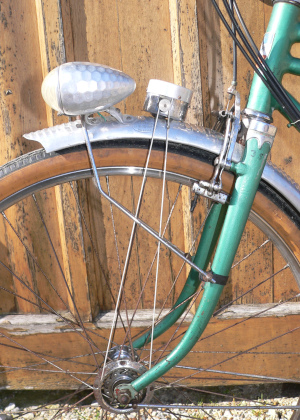
The Rigida wheel rims are simply marked Deco-B, and fitted with Michelin amber-wall tyres sized 650-BSC, 44-584, and you might think you’re probably not going to buy those at your local cycle shop these days … but the modern so-called 27½" tyres are the same size.
The rear wheel has a balancer flange on the opposite side to the 115mm half-width hub brake but the ‘Frein Tambour’ stamped on the brake-plate was not being particularly helpful, since this simply translates as ‘drum brake’.
The front brake is only a basic cycle calliper, so not any particularly effective stopping power considering there are generally likely to be two adults aboard, and since a motorised tandem can be capable of building up a fair pace. The handlebars are, however, equipped with long motor cycle chrome brake lever sets with ball-ends to maximise the applied leverage—and you can be sure there’s going to be lots of that if you want to stop on these generally ineffective brakes. Extra controls for the engine are a rotary lever on the right side to control the throttle, and another rotary lever on the left to operate the decompressor.
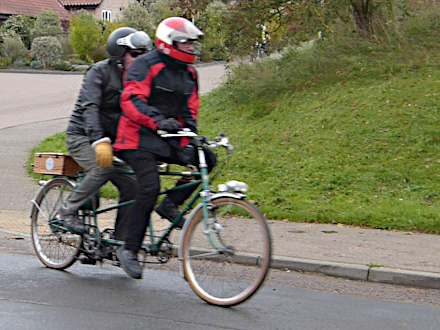
If you’re planning to ride any tandem, its generally easier to manage when you have two people who are familiar and synchronised with the process of getting underway and riding one of these things. Not only has the physical size of the bike to be taken into account, but you also need to keep in mind that the two pedal sets are connected by a chain between them, so the pedals go round together.
Solo riding a tandem is generally harder work than riding a solo bicycle, and riding a motorised tandem adds a whole second level of complication; just starting this machine is something that a solo rider is somewhat unlikely to manage. The motorised tandem is definitely a team event.
Once the fuel is turned on, you might normally expect to be using some choke or enrichment device to aid cold starting, but the engine is inconveniently low-mounted at ground level, with the carburettor practically inaccessible between the chainwheels each side, the rear bottom bracket & frame above, and the engine below. The carburettor appears to be a French-licensed Dell’orto copy, and there’s a flood button on top of the float chamber, but so completely out of reach that it’s just been sealed off with a red plastic cap to prevent the ingress of water and dirt in its vulnerable location. The strangler on the front of the carb is held in ‘open’ setting by a small strap and hook latched into a small hole on the cover lever, to stop it from vibrating or jolting the shutter into closed setting. The strangler can still be used by simply unlatching the hook, but after starting would need the bike stopping again to re-latch the hook ... so generally it proves easier not to bother with the strangler and just keep pedalling until it starts without the choke.
With the drive lever set ‘on’ to engage the roller, turn the decompressor lever to on, then you’re pretty much ready to mount up and pedal away. Once sufficient cycling speed is built up, then the pilot can drop the decompressor while playing with the throttle lever to try and get the engine firing, and with the team digging into the pedals to keep the motor turning. Engine control operations, steering and braking are performed by the pilot up front, while the ‘stoker’ only has a fixed-straight set of handlebars to hold, and pedals to assist when commanded by the pilot during uphill climbs that might overcome the straining little engine.
The SER–Itom engine has an exhaust, but definitely not a silencer; it’s far too loud to qualify as that.
The 70-year-old motor labours constantly in its eternal struggle to propel the tandem along with two adults aboard, frequently calls upon its riders to help maintain its optimum running speed, and cries desperately for help when faced with a hill. On a good day, on slight downhill runs or along the flat with a light tailwind, I’ve ridden beside this tandem on a pace bike with the sat-nav clocking 31–32mph, which seems to fairly corroborate the reported speedo readings.
Much of the time however, the tandem requires pedal assistance to pull away, and to build up enough running pace for the motor to take over. Headwinds and light inclines will always bring the team riders into play, and steep hills will generally overwhelm all efforts since there is only a single speed freewheel, at which point the team is reduced to the indignity of pushing the tandem up the hill. Its lack of multi-speed derailleur gears isn’t always made up for by the motorised conversion.
The situation can be reversed when the bike is bowling downhill up to 30mph, when it’s discovered that the largely ineffective brakes prove to be quite marginal in arresting the bikes descent under the influence of gravity. It’s more prudent to throttle back the engine when approaching down gradients, then descend in a more stately manner at a controlled pace.
SER primarily operated as a proprietary engine builder but didn’t seem to have produced its own complete machines. ‘Lepicard’ LP1 49cc and LP2 65cc motors were sold to other manufacturers including AGF, Bondi, Esper, Isoflex, Le Sauvage, Narcisse, Riva-Sport, Robert Oubron, Royal-Codrix, Stella, and Mercier who also built Louison Bobet and Lapébie branded machines. The 49cc version was made in higher volumes, as fewer manufactures took the 65cc version: AGF, Isoflex, Libéria, Mercier, Motobloc, Onoto, Pfohl, and Stella. SER engines can also be found in Mercier and Pélissier light motor cycles using kickstarter versions of the LP2 motor.
SER manufactured thousands of the Itom-licensed cyclemotor engines, which were readily compatible with most bicycle makes, and also adopted by numerous moped manufacturers: Ninon et Stella in Nantes, Gitane in Machecoul, Onoto in the Jura region; Lucer et Bertin in northern France, Guiller in the Vendée, Le Sauvage in Paris, Mercier in Saint-Étienne, Talbot, Semper, and many others offered at least one SER–Itom motorised model in their ranges.
Following discontinuation of the licensed Itom motor, the SER company seemed to disappear in 1958.
SER mopeds were built in Spain by the Industrias Reyac Aralar company in Pamplona, using LP1 and LP2 engines built under licence from 1956, and continued after the French SER company had ceased production.
The Ocariz company (owner of Lanch brand motor cycles) manufactured the engines for the SER and Lanch brands in Tolosa, while the Reyac company manufactured the chassis for both brands in Pamplona.
Spanish regulations changed in 1962 making the continued production of these machines unviable, so the firm switched to manufacturing household appliances.
Financial difficulties at Maire and Vuillemin brought their competition and sporting activities to an end in the later 1950s, and following what was described as ‘serious management issues’, Mervil reportedly closed in 1962. Presumably the Paul Maye–Mervil factory in Bordeaux also ceased in collateral fallout.