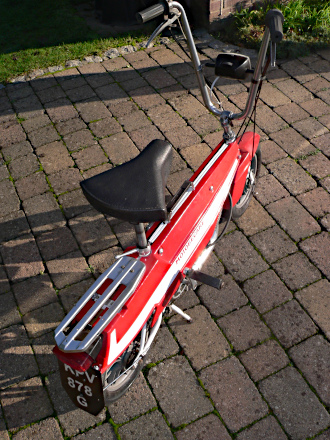
Any owner of a Motobécane X1 very probably finds its motor performance somewhat lacking, so one might ask how it can be improved? Since the bike employs a unique design of Cady engine, it involves a correspondingly unique frame to mount it, so no other motor type can be readily employed without significant adaptation.
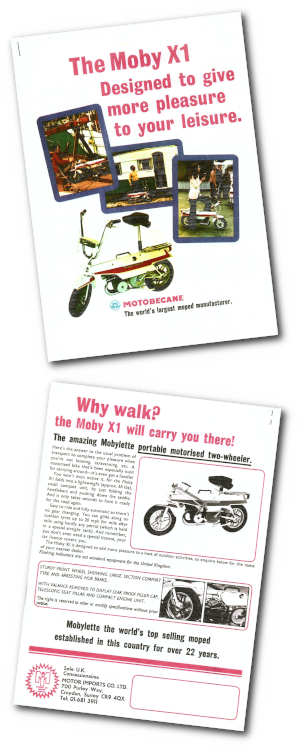
To provide an answer, we need to appreciate the problem, which may lie in the text of our ‘Micro Solution’ article back in January 2012.
‘A Motobécane Cady motor lies at X1’s beating heart—an interesting choice of engine offering miserable performance with wretched serviceability issues to the ignition set, and presumably selected on the basis that the model was probably never intended for speed …
‘X1’s biggest let-down has to be the miserable Cady Isodyne engine, which pathetic output restricted its performance to the 20mph category. This may be considered adequate as a micro-compact for camper site use, but not really effective as a proper moped since it wholly lacked the capability to keep up with general 30mph town traffic pace.
‘X1’s performance would prove a practical limitation to its sales capability, which Motobécane addressed to some degree in the later X7 version, installed with a 2bhp M-series motor. The X-series, however, proved more novelty than longevity and, as is often the way with these flighty mini-bikes, its customers moved on to new novelties. After just 5 years’ listing, the models were discontinued in 1976.’
Doesn’t sound very encouraging, but what did the actual road test report?
‘We open the throttle to pull away … Not quite what you might ordinarily describe as acceleration …
‘To be honest, it’s pretty pathetic, and you really do need to give a little pedal assistance or you might be at the kerb all day! The clutch locking shoes seem to engage somewhat prematurely, and the feeble Cady motor just labours in vain at low revs.
‘Pedal assistance also needs to be something for cautious consideration, since the pedal arc takes them fairly close to the ground, there’s not much free clearance, so you might be in danger of hitting your feet—that can really hurt, and cause a further painful spill.
‘Once you’ve got underway, there’s a brief illusionary moment where you optimistically think “maybe it’s picking up now”—no it isn’t! That’s all there is!
‘Along the flat and according to wind conditions, the Cady will generally grovel up to 15–18mph, maybe even touch 19 or 20 with a decent tailwind on a good day. Even gentle gradients just seem too much effort for the indolent motor, which readily fades down to 13mph in a general performance that seems more comparable with ancient and primitive cyclemotors of the 1950s.
‘Turning back the way we came, the same light downhill run gave our absolute best-paced reading of 22mph, at which there’s a lot of vibration being created by the overhung crankshaft motor. This is an engine design that particularly doesn’t like to rev.
‘From the riding position, and looking down on the retro ’70s missile bodywork may conjure some rocket jockey image, but the reality of Cady’s engine performance is a sobering illusion—not for nothing was the white X1 more commonly known as “The Albino Slug”.
‘Anyone getting on an X1 is generally going to be thinking there’s something rather wrong with its motor, but no, everything is normal; that’s just how the Cady engine is. The “blank” right hand crankcase cover pretty much gives away that the motor has an overhung crank. The drive journal on the left-hand side runs a smaller version of the usual Dimoby automatic clutch, with inboard pulley and belt guarded by a snap-fit plastic cover. The mag-set, however, is mounted between drive pulley and the engine, which means you have to remove the clutch in order to simply adjust the contact points—which rather tends to be a bit of a service issue!
‘The exhaust pipe exits to the right-hand side front of the cylinder, while the inlet manifold enters to left-hand side front of the cylinder, with the pipe snaking its way back around the cylinder, where a 10mm Gurtner carb mounts at the back right-hand side. An 11-inch (270mm) long intake manifold on a two-stroke is obviously not going to help its performance, when nearly half of the induction volume of each stroke is lost in the inlet manifold.
‘The engine configuration is generally summed up as “why on Earth did they do that?”
‘There didn’t appear to be much ready reference at the time to actual power outputs, but both the M1 Cady and X1 models using the Isodyne motor quoted a maximum design speed of 33km/h (about 20mph).’
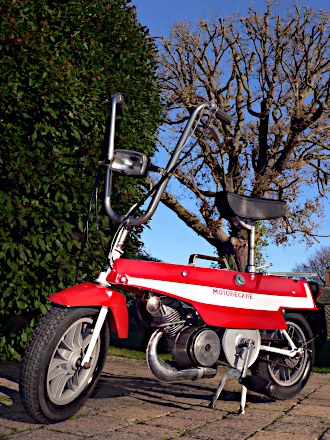
None of these references seems particularly encouraging, and it already seems like Mission Impossible, so why are we here?
Well, there’s a customer’s X1 in the workshops with a really sick engine. It’s been smartened up in the past with a ‘reverse pattern’ paint job, but just stood around for many years as an unused fashion accessory, so the engine has ‘frozen up’ with a seized piston in the bore, condensated main bearings, big-end and small-end bearings, and is basically completely kaput.
Can we fix the engine? Err, it’s really not actually worth the cost of fixing, and we don’t have the parts … but we do have a later Super-Isodyne engine that would fit, and might even be a little better …
So it came to be that maybe for the first time ever, a Super-Isodyne engine was destined to be fitted into an X1, not particularly because it was intended to improve the performance, but just because it’s what we had, and would go straight in.
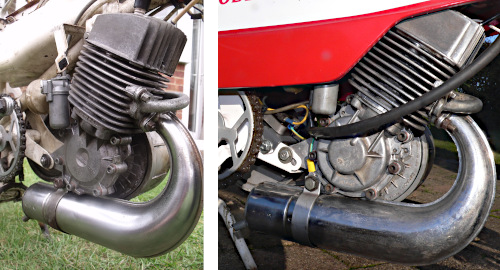
Isodyne engine [Left} & Super-Isodyne engine [Right]
The new ‘Super-Isodyne’ engine arrived on the UK market with the introduction of the Cady M3 models in April 1974, and though the X1 continued on listings to March 1976, it was never fitted with the new motor.
We road tested a couple of M3 Cady models with Super-Isodyne engines in October 2016; they averaged around 27mph on the flat in an upright stance, which seems some improvement on the 20mph expectation of the M1 and X1 Isodyne motor. The new ‘Super’ engine type was apparently rated as exactly the same 1bhp@3,600rpm general specification as the previous Isodyne engine, and differed only in replacement of the original overhung crank design with a conventional twin-flywheel configuration crank supported by a short journal and bearing on the crankcase cover side.
But are the gearing ratios compatible?
Looking at the comparative drive ratios:
X1 = 2.50 – 9 tyre = 14" diameter with 25T sprocket
M3 = 2.25 – 16 tyre = 20.5" diameter with 36T sprocket.
Surprisingly, both divide out to 0.56, so they’re both the same drive ratio, while all other technical aspects are the same.
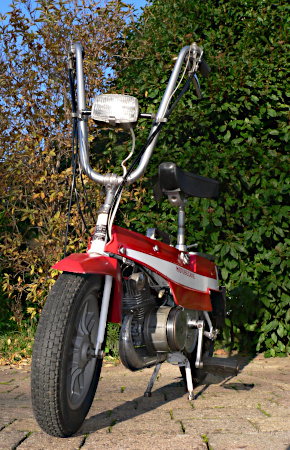
The only difference observed between the M1 Cady/X1 Isodyne tests, and the M3 Super-Isodyne tests was that the Super versions experienced less vibration, and vibration can equate to lost power.
Now the installation is done, could it actually make any difference? Maybe fitting a Super-Isodyne motor might just make the X1 go a little better?
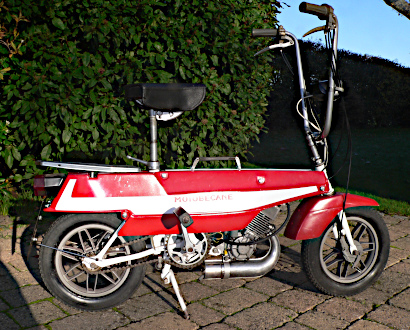
Our Super-Isodyne X1 is quite distinctive with its reverse colour scheme of red background with a white stripe, instead of the original white panels with a red stripe.
Neither the Cady Isodyne or Super-Isodyne engines produce any meaningful power, and when power is the operative word, no Cady motor has that.
Pull-off is still poor since the single-speed clutch shoes lock in at low revs, and same low-power 1bhp motor still struggles to labour up to higher revs.
The whole X1 riding position is really horrible. You’re perched atop a poorly sprung saddle with a nasty plastic cover, on a mini-bike with no suspension and awful narrow pull-back handlebars that make the bike feel terribly unstable over bumps and around corners. The X1 really isn’t anything you’d feel confident about even trying to go faster on.
Our Super X1 paces around 20–22mph on flat, with a best of 25mph on a light downhill run, so generally paces just 2–3mph higher than the Isodyne X1. The only appreciable improvement seemed to be some reduction in the level of vibration: though it does still vibrate, the vibes just come in a little later.
The Super-Isodyne M3 Cady models also vibrated, though a little further up the rev range, and managed a better performance than the Super X1 with the same engine and the same final drive ratio. The only other factor influencing when the rev range affects these different machines would be the frames, the suggestion being that the X1 frame/engine installation might be more susceptible to vibration than the Cady frames.
Was it worth the trouble for just a couple more mph? Probably not…