 Go to the Archive index
Since its launch, the infamous Raleigh Wisp has long been tainted with a reputation for sedate performance. However, this serious and intensive study would seek to show in part that Raleigh sought to address this problem that blighted its first models.
The earliest Wisp seems to appear in the Raleigh Sales Brochure, with a D-registration (1966) while most machines reached the general public between 1967 (E-reg) to 1969 (G-reg). Along with the launch, the national dealer network was issued a ring bound Raleigh Industries Service Data Manual, examination of which for the rear wheel (SL12) and Technical Data (WM5) lists the installation of a 44t rear sprocket paired to a 12t front. This gave the highest standard geared combination available from Motobécane at the time of 13.8:1 (exactly the same as comparable RM4 & RM6 models), but the tiny 12" wheels (16" diameter) could hardly convert this to the same drive ratio as the 19" (23" diameter) Runabout wheels (50" circumference as opposed to 72"). This 44t sprocket is clearly pictured on the brochure illustration models and goes some way to explain the under-geared 25mph maximum of early machines, which must have screamed their little hearts out! Resultant complaints of this stunted top speed, and the associated mechanical problems with the constant over-revving, prompted the rapid creation of a unique 36t rear sprocket made especially for the Wisp. This can be seen on most of the later machines and gives a more suitable 11.3:1 ratio in combination with the same 12t front sprocket.
Further to the gearing situation is the specified engine power output, which is given in the Technical Data as only 1.4bhp while most basic Motobécane ‘split fin’ motors produced from 1963 are rated at 1.7bhp, despite both types being fitted with the same AR10 carburettor. Made solely on the theory of keeping the float chamber level, the special Wisp inlet manifold with its increased tilt angle to compensate the more inclined engine installation, is only bored to 8.6mm, though this barely accounts for the 18% de-tune! The principled intentions appeared unnecessary since in tests the carb does seem to function satisfactorily with a slight downdraft, so fitting a standard 12mm Moby inlet could help the breathing (or just open out the standard manifold).
Trying to find further explanations, it could be necessary to look further back to earlier ‘continuous fin’ Motobécane motors as fitted to RM4s. These machines also produced only 1.4bhp, also with the AR10 carb, and were superseded in 1963 by the ‘split fin’ with its 1.7bhp output. So what are the differences? Comparison of the barrel porting arrangements reveal the same 18mm × 6mm transfers, though the 20mm wide exhaust port is only 7mm high on the ‘continuous fin’ compared to 9mm high on the later ‘split fin’. It seems possible that carrying over the earlier porting arrangement in the casting could have restricted the Wisp’s ‘split fin’ barrels. [Note: all types of Raleigh licensed engines were identified with an R prefix to the serial number on the cylinder barrels.] Another notable difference occurring around the mid-60s was an increase in compression ratio of the ‘round fin’ cylinder head from 6.5 to 7.5:1. Having identical external appearances, this only becomes discernible inside the combustion chamber as the earlier lower ratio features a full natural hemisphere blending to the gasket face, while the 7.5 shows a reduced hemisphere giving a small step to the gasket face with a recessed plug thread and decompressor valve. The difference in volumetric capacities of 6.7 to 7.7cc is quite subtle and to the layman may only be discernible by the comparison of various heads.
Over the years, many Wisps may have experienced engine or component changes to confuse the original specifications and result in some of the various performance differences seen between machines today. Raleigh’s original intention to de-tune the Wisp motor may have been attributed as a discretionary reaction to the machines ‘twitchy’ handling due to the combination of tiny wheels, suspensionless construction and high centre of gravity from the rider perched on top of such a light machine. More likely though, it was to try to compensate over-revving with the low drive ratio on the earlier models, later machines probably used the standard 1.7bhp motor once the drive ratio was improved. Rating to 1.7bhp specification with 36t gearing should hold little to concern the average Wisp rider used to the nervous handling, but the next chapter promises to take the reader into uncharted territory and is not for the nervous or faint hearted! Chapter 2, ‘Wisp with a sting’, offers practical tuning up to twice the originally specified power output—2.7bhp! Blueprint those braking systems and journey into the secret world of the ‘Suffolk Racers’ as development over three decades results in the first working prototype of the ‘Raleigh Wasp’, where no Wisp has buzzed before!
First published, June 2001
By the spring of 1967, Raleigh was already offering a staggering range of no less than nine mopeds, the RM5, three models of RM6, RM8, RM9, RM9+1, RM11 & RM12; but one more extraordinary machine was yet to join them. The story starts with the unprecedented popularity of a humble bicycle that caught the imagination of the swinging sixties and found the factory swamped by demand, leaving customers queuing their orders on cycle shop waiting lists. Then, at the height of the craze, in a marketing masterstroke, Raleigh ingeniously installed the RSW16 bicycle with an engine to create one of the ‘smaller’ icons of the time. As much a symbol of the period as Mick Jagger, The Mini Moke and Hot Pants, its flashing gold or blue colours glinted in the eye of fashion and anyone could become a part of the ‘with-it’ world, simply by riding—The Raleigh Wisp!
Of course now, we all put them down as an eccentricity of the day, but the Raleigh Wisp is actually one of the Great Classic Mopeds! It broke the mould and captured the spirit of the time. Ride a nice one through the town centre traffic on a sunny day and watch the smiles—people love it. Thirty years on and the ‘Kit Bike’ styling still makes the cut, the magic’s still there! They don’t know the thing handles like a nervous spring and goes like a lethargic snail, but with a little imagination, something can be done about that.
Everybody who’s ever ridden the notoriously twitchy little beast would probably sensibly conclude this is the last machine you’d want to consider for tuning, but think about it, there aren’t many machines that could offer the benefits of the Wisp’s power to weight ratio. Though the feature bike appears absolutely standard apart from its bright red ‘warning’ paint work, it’s fair to say there have been some pretty dramatic modifications under its sheep’s clothing.
Basically, the motor has been raised even beyond AV89 specification by skimming 0.75mm from the head face and running without the 0.75mm head gasket by sealing with copper silicone. Though this is not recommended by the product manufacturers for general applications, it seems to work fine in our little engines. This results in a compression ratio increase for the 7.5:1 head, to a fearsome 10.2:1 (standard AV89 is 9:1), and necessitates readjustment of the ignition timing to 1.5mm BTDC to compensate. To move up the power band, the barrel is replaced by a visually identical round split-fin AV89 pot & piston to raise all the porting by 2mm and turn the piston notch to the exhaust. Lubrication to the mains is improved by upgrading to M40 crankcases which ‘drain feed’ from the transfers to the back of the bearings.
For the motor to gain the benefit of these internal changes, it is necessary to chuck away the standard AR10mm (78.5mm²) carburettor and refit the bigger H14mm (153mm²) Gurtner from an AV89. The 95% flow capacity increase is just the ticket but becomes a bit tight on space for installation with the matching carb manifold, so two manifolds were cut and alloy welded to reproduce the same tilt angle of the original Wisp component. Special choke and throttle cables were made up to provide the required increase in slider ranges, and the AV89 air box cut away to fit, leaving just its velocity stack core with end filter elements. This results in much increased induction roar, which is about the only thing that gives the game away since this very obvious modification is completely concealed beneath the chain cover. A larger capacity silencer chamber is discretely squeezed in beneath the frame to accommodate the increased gas flow.
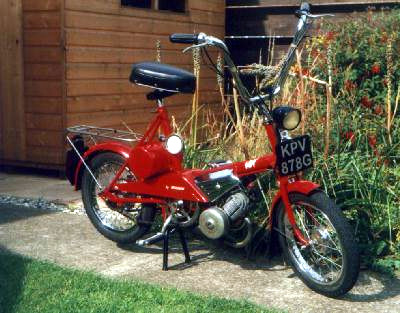
The improved power output means you can easily handle raised gearing by adding another tooth to the front sprocket. You’ll find the 13T has a larger bore and requires a different locking arm to engage, but the easiest solution to this problem is replacing the whole flywheel/sprocket assembly with an M40 one which is characterised by having a beneficial reinforcing lip around its rim. The 13T to 36T combination reduces the overall drive ratio from 11.28 to 10.4 and represents an additional 2.4mph @ 30mph based on the same revs. To monitor the effects of the modifications, an £8 digital cyclometer can easily be programmed to the wheel size, giving the Wisp an accurate speedo where none could previously be fitted as no mechanical set on the market ever had ratios to suit the tiny wheels.
Well there you are, you’ve doubled the bhp from 1.4 to 2.7, so now you need to ask yourself—are you brave enough to go for a ride?
Starting is exactly the same as the standard motor, and can still be set up to tick-over in the normal manner. A lightly pedal assisted take-off helps with the taller gearing and the fact that the raised power band of the motor doesn’t start kicking in till the revs get up. Handfuls of throttle result in a great gulping induction roar and the effects of the modifications become apparent by 15mph. The torque increase is very evident as this machine actually accelerates up hills! At 30mph where a standard Wisp is running out of puff, the Wasp is really climbing into its power band and literally bursts away as the throttle is cranked open. This afterburner effect is just simply devastating to any accompanying rider on a normal moped or autocycle since nobody can ever be prepared for a Wisp to go blasting away from them at 30mph, it just never happens!
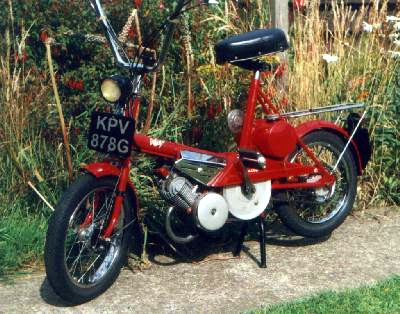
The benefits of the tiny Wisp wheels are that the brakes are always brilliant, and still well up to the job for the increased performance. OK, the handling is simply terrifying, hand signals are only brief waves at best on a normal machine, but on this thing there’s no way you ever want to take a hand off the bars. The Wasp is ‘hold on for grim death’—it’s a white knuckle ride! ‘Unfettered’ by the Motobécane vario system, The Wasp is built with a fixed engine and does everything by sheer power and revs, which results in the motor screaming to a howling crescendo. Sure it’s mad, it chews up belts, spits out clutch shoes and knocks out spark plugs. It’s a hand grenade, and you know it won’t last, but it’s just such fun! So now the Wasp has been done, what does one do with the second project Wisp sitting in the shed? Only a complete lunatic would ever think about doing an even faster "Super Wasp" with AV89 spec motor, ‘swing engine’ and vario gear installation!
One of the many features of the cyclometer is that it automatically performs all sorts of useless functions, as these modern digital things tend to do. Just by pushing a button you can page through all these operations in sequence, one of which records the maximum speed to date. 44.4mph! Surely not, Wisps can’t go that fast—it must be programmed wrongly.
First published, August 2001