 Go to the Archive index

Spotted at the Airship Run—8 Sep 2013
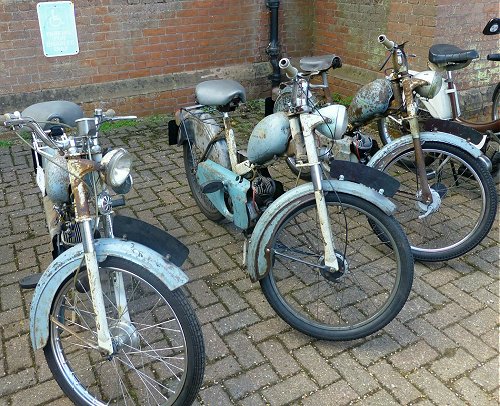
You don’t see a Hercules Corvette for ages—then three turn up at
once.
Of course, this didn’t happen by pure chance although there was a
certain amount of coincidence in there being three Corvettes up & running,
taxed & tested, and available.
Getting three Corvettes to the start was one thing, getting them all
round the course was quite another. They all broke down—one of them
broke down twice—and none completed the run under its own power.
However, the following weekend, all three were at the Coprolite Run and,
this time, all three were successfully ridden all the way round the
route.
Powered by a Lavalette engine and utilising several parts from the
Phillips Panda Plus, the Corvette was produced for less than two years,
being launched soon after the TI–Raleigh merger in 1960. It ceased
production in 1961 after the decision to replace all TI’s moped ranges with
licence-built Mobylettes.
First published in The MAC in December 2013
Go to the Archive index
Spotted at Kneel’s Wheels—17 Nov 2013
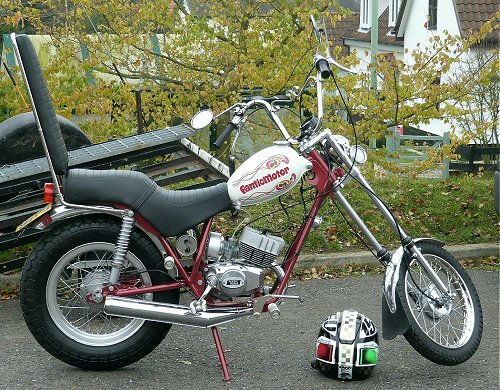
This one was the head-turner at our AGM run:
a Fantic Chopper.
Fantic produced the Chopper in two sizes: 125cc and 50cc; this one, as you can tell
from the pedals, is the 50cc version. This is a ‘sixteener special’: one of the
machines that the moped law was changed to outlaw n the 1970s. Being
under-50cc and with pedals made it legally a moped that could be ridden at
age sixteen. A contemporary road test (Motorcycle
Mechanics, December 1972) reported that it was the most powerful
moped they’d seen and was capable of just over 50mph … or a bit more under the right conditions.
This is Paul Kelling’s latest acquisition and he only collected it a few
days before Kneel’s Wheels. Not surprising, therefore, that it
suffered from a few teething troubles on the run. What’s it like to
ride with that long fork? Paul’s own observations mirrored those in the
1972 test: ‘Handling came as a big surprise, simply because it did … the
roadholding proved better than many machines of comparable
performance. Manoeuvrability too, wasn’t too bad, considering the
57-inch, wheelbase.’
A teenager’s dream from the ’70s and, for most, only a dream because
very few teenagers would have been able to afford one.
First published in The MAC in December 2013
Go to the Archive index
Spotted at the Mince Pie Run—29 Dec 2013
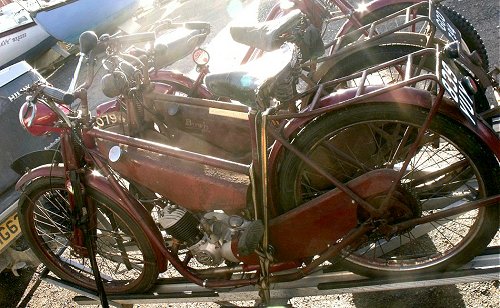
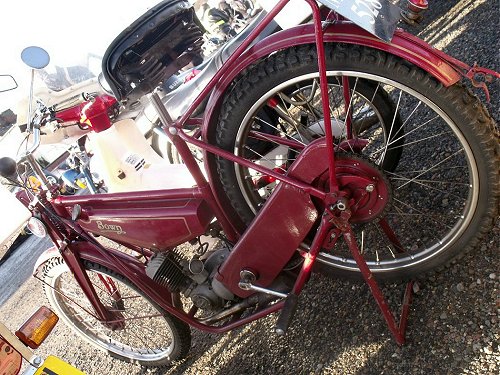
In the last issue we said ‘You don’t see a Hercules Corvette for
ages—then three turn up at once’. Now we could say the same about
Bown autocycles at the Mince Pie Run. Not quite the same though
because we do often have a Bown at EACC runs.
Bown was an old-established cycle and motor cycle manufacturer that
became part of the Aberdale Cycle Company in the early 1930s. William
A R Bown had a seat on Aberdale’s board and was commissioned to
produce a replacement for the Aberdale autocycle for the 1949 season.
The replacement was needed because of the introduction of the
Villiers 2F engine and all makers of Villiers-powered autocycles were
redesigning their Junior de Luxe engined machines to use the 2F.
Although scheduled to start production in March 1949, Aberdale was
provided with a factory at Llwynypia under the Labour Government’s Advanced
Factories Scheme, so introduction of the new autocycle was delayed until
the new factory was up and running. This factory produced both
autocycles and motor cycles, which had originally been shown under the
Aberdale name at the 1948 Earls Court Show. February 1950 saw the
autocycle’s appearance on the market, branded as a Bown product.
The new frame was unusually well engineered for an autocycle, being a
cradle type with duplex down tubes. Otherwise, the Bown had all the
usual features of the 2F ‘family’ of autocycles: 4-inch hub brakes front &
rear, Villiers lighting set, lever operated throttle, strong rear carrier,
rear stand and pressed steel girder forks. Some more individual
features were inverted brake levers, a box silencer mounted between the
frame rails under the bottom bracket and a spring loaded jockey wheel to
tension the pedalling chain. The colour was maroon with gold lining
and its price (in March 1950) was £58 15s 8d [£58.78], which
included £12 10s [£12.50] Purchase Tax.
The delay in getting the Bown into production was not good as 1950 was
pretty much the beginning of the end for the autocycle era; demand for this
type of machine declined from then.
Even a reputation for being well-built machine couldn’t stop Bown sales
from declining along with nearly all other autocycle makers. The
autocycle ceased production and the Welsh factory closed at the end of
1954.
That wasn’t the end for Bown: in November 1955 the name re-appeared at
the Earls Court Motor Cycle Show on a new moped. The Aberdale Cycle
Company also had a profitable line in its Gresham Flyer children’s
tricycles. In 1958, Aberdale was acquired by Tube Investments, mainly
because TI wanted to acquire the rights to the Gresham Flyer.
First published in The MAC in March 2014
Go to the Archive index
Spotted at the Mince Pie Run—29 Dec 2013
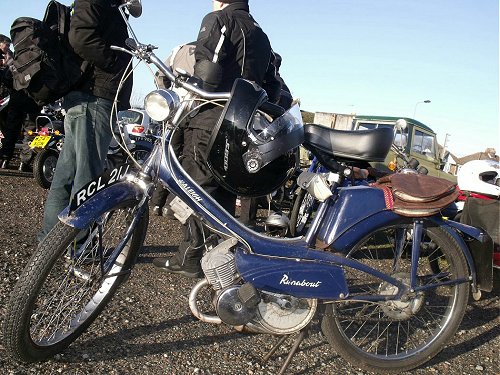
This is Barry Yallop’s Raleigh Runabout, a regular sight at our runs in
Suffolk.
The Raleigh Runabout RM6 was introduced in May 1963 at the Blackpool
Winter Gardens Show. The Runabout was based on Motobécane’s
Mobylette AV42.
Over the years, the Runabout became the mainstay of Raleigh’s moped
range. In addition to the standard version, De Luxe and Super de Luxe
variants were introduced, along with the very basic ‘Pop’ model.
Other models in the Raleigh range, from the RM8 Automatic Mark II to
the RM12 Super 50 were all based around the Runabout frame.
Barry’s RM6 dates from 1971, right at the end of Raleigh’s moped
production. By this time, the range of Raleigh mopeds had dwindled
until the standard Runabout was the only one left.
The first Runabouts were finished in a two-colour scheme of Raleigh
Green and Pearl Grey. An all-over light blue (Neptune Blue) colour
scheme was adopted in 1965 while the De Luxe models were painted
Carmine Red. The ‘Pop’ was introduced in 1966 with its cheapness
being emphasised by it simple black colour.
Barry’s Runabout is finished in Royal Blue. This darker blue
colour was introduced in 1967 and lasted until the end of production.
First published in The MAC in March 2014
Go to the Archive index
Spotted at the Radar Run—13 Apr 2014
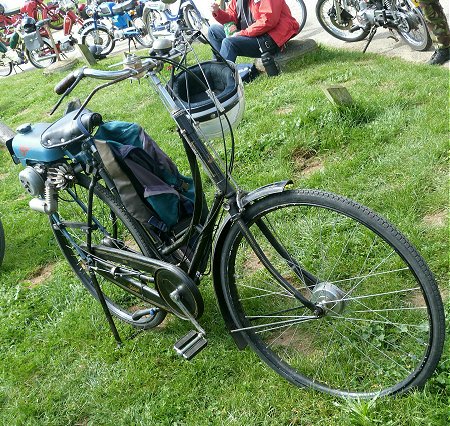
This machine attracted a good deal of attention at the Radar Run,
particularly from the bicycle enthusiasts.
Let’s start with the motor: it’s a Trojan Mark 2 Mini-Motor dating
from 1951.
Now the bit that attracted the attention of the bicycle fans: a 1933
Special Raleigh. In the heyday of cyclemotors UK purchasers could avoid Purchase Tax by buying
cycle and engine separately. However, an even cheaper option was to
just buy the engine unit and fit it to a bicycle you already had.
This meant that a good many cyclemotors were mounted, like this one, on
older cycles.
The Special Raleigh was particularly suited as a cyclemotor mount, being
very well made and having drum brakes on both wheels. The three-speed
gear helps too: low gear is best for starting the engine and the high gear
mans you can give the engine some LPA to keep the revs up on inclines.
A high-quality bike costing 10 guineas when new in 1933; in terms of
average wages, that works out around £2,500 in today’s money. If you
know your Raleighs, you’ll spot something odd about the brake rods: the
rear brake rod is beside the steering head instead of in front. But
that’s exactly what the 1933 catalogue shows for a drum-braked bicycle and
seems to be something Raleigh only did for a couple of years.
First published in The MAC in June 2014
Go to the Archive index
Spotted at the East Anglian Run—18 May 2014
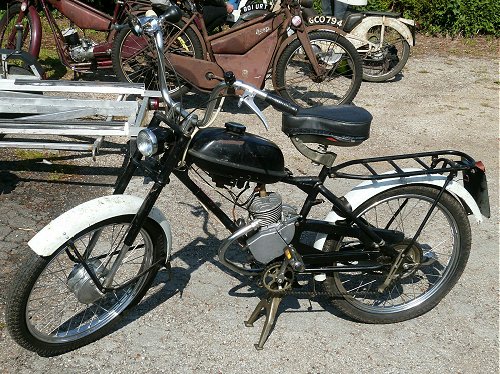
Our next bike is something quite different: A Red Star Riga-413 dating
from 1992. The 413 is a variant of the Riga-13 model that was made
from 1982. However, the basic design dates back to 1966 and the
Riga-5.
All these models of Riga were powered by Red October engines, which were
little more that a cyclemotor engine. The Riga-13 models used the Red
October D8 series of engines and the 413 has a D8e.
Broadly speaking, the Latvian Red Star factory produce two kinds of
moped. Riga-5, 7, 11, and 13 were basic, single-speed machines that
were little better than cyclemotors. The others were more like
‘proper’ mopeds, using a two-speed engine with built in pedals (or
kick-start on the later models).
The dissolution of the Soviet Union in 1991 heralded the end for Riga
mopeds. The factory closed in 1998 but moped production had already
dwindled to nothing several years before that.
This Riga was at the run for inspection and dating so, although it
didn’t go along on this run, we may see it in action soon.
First published in The MAC in June 2014