 Go to the Archive index
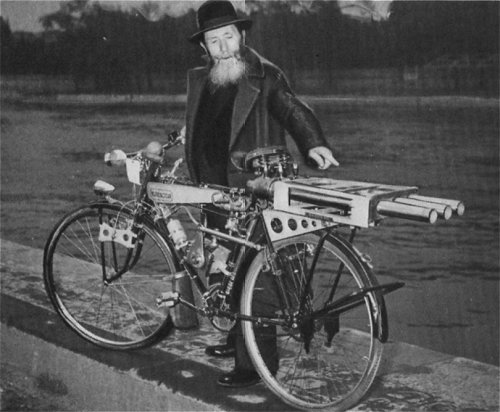
I enclose this photo of a 1931 rocket-powered cyclemotor in the hope that it may inspire the Richard Nobles in Mark Daniels’s Suffolk racing fraternity to progress beyond the restrictions of traditional internal combustion machines to what must surely be the cyclemotor for the new millennium. With such a steed, the Coast to Coast could be negotiated in minutes; while with suitable modification and moderate LPA, intergalactic cyclemotoring could easily be achieved. It may, however, be necessary to shop around for an MoT station prepared to issue a certificate of spaceworthiness!
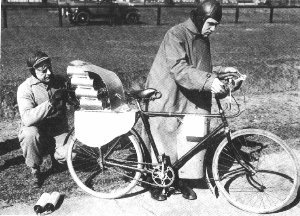
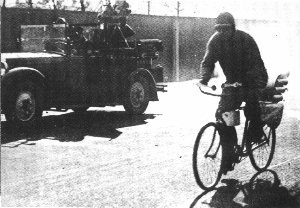
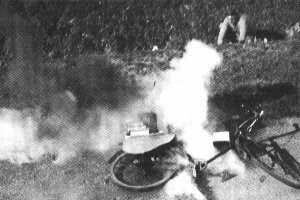
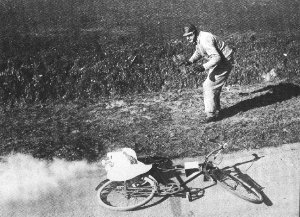
The intrepid cyclemotorist in the photo was only slightly injured when, at a speed of 90km/h, he was thrown from the track & his cycle exploded. Better order those asbestos trousers Mark!
[The ‘intrepid cyclemotorist’ depicted was a German engineer named Richter and the test of his cycle, powered by 12 rockets, took place at the Avus race circuit. Although the predicted speed was 90km/h, I believe that the cycle only reached 30km/h when it became apparent to Richter that things were getting uncomfortably hot and he ‘abandoned ship’. The entire episode was filmed and it would be interesting to hear from anyone who has a copy of the film.
First published in Buzzing, April 2000
Twenty years after Richter’s rocket-propelled bicycle, in 1951, this French-made ‘Véloréacteur’ received a fair bit of attention in the press.
It is pictured here along with its designer, Pierre Noubel [*]. There are no photographs of it in motion. However, the machine still survives and is currently (June 2008) on display at the Musée de la moto et du vélo, Château du Bosc, RN100, 30390 Domazan, France.
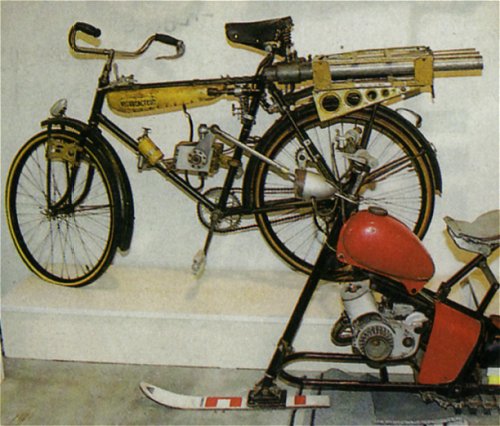
Note: Some sources wrongly give the designer’s name as Louvel.
Looking for informations about jet propelled mopeds and motor cycles, I found the Moped Archive (quite interesting and humouristic, bravo) and read the text entitled Rocket Bike Ⅱ featuring the French-made Véloréacteur. There was a question about the Véloréacteur builder’s name: I can confirm that Pierre Noubel (not Louvel) is the name mentioned by period motor cycle press.
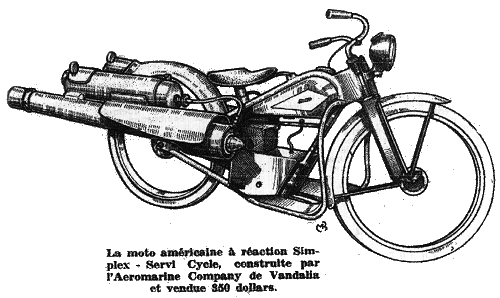
I send you two odd pictures found in Moto Revue (in 1949 and 1951 issues): in the first one (found in an item about jet engines and their possible application to motor cycles) we can see what Moto Revue called "Simplex—Servi Cycle, built by the Aeromarine Company". In fact the Simplex Servi Cycle was a pre-war US 125, used during WWII as a paratroops’ lightweight motor cyle and still in production on the 1950s and early 60s. Here, the original two-stroke engine has been taken off and two jet engines fitted.
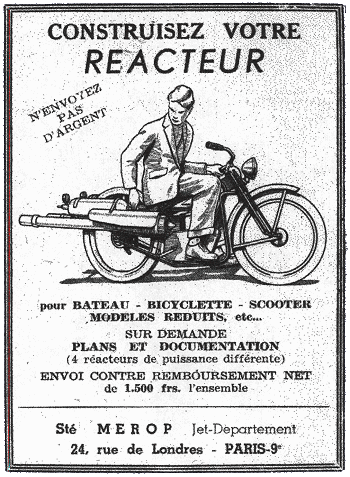
BUILD YOUR OWN JET ENGINE
Don’t send any money
for BOATS—BICYCLES—SCOOTERS—SCALE MODELS etc...
PLANS AND DOCUMENTATION ON REQUEST
(4 different capacities jet engines)
WE SEND FOR FF1,500
MEROP Co Jet department
24 rue de Londres
Paris 9.
I just know a few details about this oddity: the Aeromarine Company in Vandalia, Ohio, USA built little jet enginess for scale models but I doubt that they ever built and sold any jet popelled Servi Cycles. In fact these two pictures have been drawn by the same draughtsman (Moto Revue employed a full-time draughtsman and these two pictures are in exactly the same style as all the other ones in this period’s Moto Revue issues). I guess this machine never existed except within the pages of Moto Revue.
This following article is about something very different, once you have read it I would suggest that you go on line and open up YouTube and type in ‘Rocket Bicycle’, what you will then be able to view is truly breathtaking.
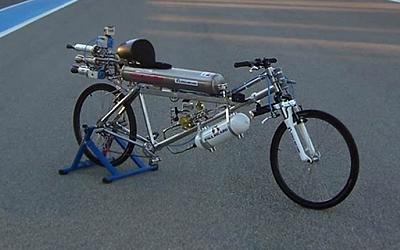
There is always a beauty in simplicity.
When I first heard about François Gissy’s exploits on a rocket powered bicycle, I could not believe it was possible. I will have to confess this has fascinated me since I viewed the record attempt last November. Over the last few months I have looked up and researched a lot of things about this very jaw dropping achievement. So sit back and have a read about the creation of a very special Cyclemotor.
This Rocket-powered Cyclemotor is the brainchild of a Swiss thermo-chemical engineer Arnold Nearcher. It’s been part of a three year development programme which culminated in an astonishing run on this bicycle which achieved 207mph in 4.88 seconds at the Paul Ricard circuit in France. Within two weeks of the attempt over a million hits had been achieved on YouTube. All the more amazing is the development of this machine has cost only £20,000, which is cheap as chips compared to what the drag racing fraternity regularly spends on its exotic machines. Apparently, so I have read, the drag racing world is pretty much shell-shocked by what has been achieved. To coin the Churchill phrase but to adapt it a little ‘never has so much been achieved for so little by so few’ (2 blokes). It’s certainly a case of something for nothing, it started life as a bicycle and it still is, it can still be cycled in the normal way without adaptation.
The bicycle itself is the third example Arnold Nearcher has produced. It’s been a case of adapting the bicycle to fit the rocket parts with an eye kept on keeping it ridable at alarming speeds. It started life as a mountain bike but has had the frame cut and lengthened to create a longer wheel base. It still retains normal handlebars for cycling but has additional clip-on style bars attached to the top of the suspension fork legs so the rider can adopt a prone position when riding at speed. Mounted on the crossbar is the Hydrogen Peroxide tank that doubles as the rider’s seat. I say seat in the loosest of possible terms as it has a hump at the rear purely to stop the rider from being catapulted off the back of the machine. Mounted to the down tube there is a Nitrogen tank, this is in turn plumbed to the Hydrogen peroxide tank. At the rear of the bike is mounted the three rocket motors. Since its inception, it started life with just one but has now grown to three as three small jets produce more power than one large jet. Inside the base of the rocket motors is an area where silver filter membranes are inserted, this is where the thermo reaction takes place. The Nitrogen pressurized Hydrogen Peroxide is forced through the silver filters which act as a catalyst. This creates heat and steam that are ejected out of the jet tubes at high velocity. Simple, pure propulsion, with no moving parts. One thing I must point out the Hydrogen Peroxide that provides the propulsion on this bike is not the strength of the stuff your wives put on their heads although the only thing familiar is that your wives and girlfriends will report that whilst the Hydrogen Peroxide is on their heads they will notice a slight warm feeling as the bleach gets to work. The Peroxide hair bleach is 3–4% proof, while the propulsion grade stuff is 82–90% proof! If you put any of that on your wife’s head it would catch light!
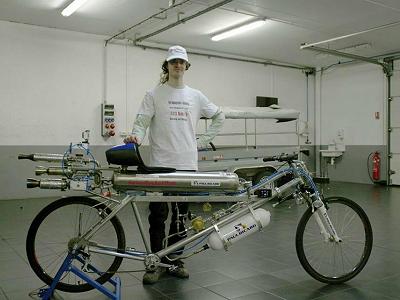
François Gissy with the Rocket bike.
François Gissy, a 33-year-old French bus driver, is the brave sole who rides this machine. He states that it is not at all easy to ride, the first second of a run is the most dangerous time as regards stability, after that you are just a passenger. Also once you hit the go button you are on a one-way mission, it will not stop until the reaction ceases.
The team feels that they could, with luck, reach 250mph, they have one more run planned for this year. They are currently in need of sponsorship, as their initial sponsor Hublot—a Swiss watch manufacturing company—seemed to get cold feet after one of their earlier runs achieved 160mph. They kind of didn’t want their firm associated with something that had a good chance of causing the death of its rider.
The team knows that if they achieve the 250mph goal that will be the end of the programme as they know that they are teetering on the edge of something very dangerous as many of the cycle parts used were never designed to do more than 35mph. Also with completely streamlined bodywork, proper braking and a parachute it just simply would not be a bicycle anymore, would it?
March 2015